
Whether You're A Small Business, Startup or A Professional,
Give Your Brand A Powerful Digital Footprint
That's Loved by Search Engines & AI Engines Equally
For A Price That's Industry Best...☝

Building Consistent Brand Citations Through Intelligent FAQ Systems
Brand visibility is no longer just about backlinks. It is about being mentioned, referenced, and trusted across the web. That is where brand citations play a powerful role. But building consistent citations can feel scattered and hard to manage.
 What if your FAQ section could quietly do that work for you? An intelligent FAQ system does more than answer questions. It repeats your brand details clearly, keeps information aligned, and helps search engines connect the dots. In this blog, we will explore how smart FAQ strategies can strengthen brand citations naturally and turn simple questions into long term visibility wins.
Brand Citations as a Trust Layer (Search, Maps, and AI Answers)
Citations are essentially distributed brand facts: your name, address, phone, hours, services, policies repeated hundreds of times across digital surfaces. AskYourFAQ reinforced this consistency by structuring verified business information in a way that strengthens entity recognition across search ecosystems. Search engines rely on these repeated patterns to build confidence around entity data.
Citation Consistency Signals That Influence Local Rankings and AI Sourcing
When Google, Bing, and Apple Maps see identical NAP information across authoritative sources, they read that repetition as verification. Entity confidence climbs. Duplicate suppression algorithms function properly. Proximity-relevance-trust calculations start favoring you over competitors dealing with messy data. AI models show similar behavior, they reference sources that reinforce each other rather than ones that contradict.
Grasping these ranking and sourcing mechanics matters tremendously, but here's the catch: even tiny inconsistencies trigger cascading problems that quietly undermine every signal you've built.
Citation Conflicts That Quietly Derail Consistent NAP Citations
uite formatting differences (Unit 5 versus #5 versus Ste 5) spawn separate entity records. Call tracking numbers overwrite canonical phone numbers. Practitioner listings clash with location listings. Seasonal hours stay live all year. Each mismatch hands algorithms a reason to distrust your data, suppress your listings, or serve stale information in AI responses.
Spotting these citation conflicts is your first step. Preventing them at scale?
That demands a system engineered to generate, distribute, and synchronize brand facts from one authoritative source.
Intelligent FAQ System Architecture That Produces Consistent NAP Citations at Scale
Most citation headaches originate from managing updates in multiple places without central coordination. One team edits the website, another updates listings, nobody tells support, until angry customers start complaining.
Canonical "Source of Truth" Design for Brand Facts
Establish a single dataset holding NAP, hours, geo-coordinates, service categories, pricing ranges, parking details, accessibility features, policies, return rules, and appointment procedures. Assign ownership. Enforce approval workflows. Track version history and maintain audit logs. Multi-location brands need parent entities structured separately from individual location entities to avoid conflicting records.
With your canonical dataset locked down, what comes next? Transforming those raw facts into standardized, reusable FAQ answers that stay uniform across every customer touchpoint.
Structured FAQ Content Models That Keep Answers Uniform Everywhere
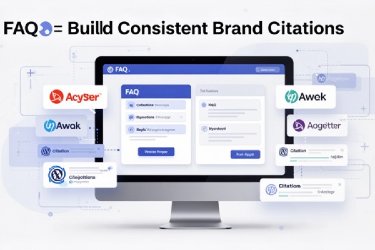 Build standardized templates for each location covering hours, directions, parking, payment methods, cancellation policies, after-hours emergencies, and service area boundaries. Enforce controlled vocabulary so service names and brand terms remain consistent. Set answer constraints: lead with a standalone fact sentence, layer in supporting details, append last-updated timestamps to signal freshness.
Structured templates lock in consistency within your content, but without automation, updates still depend on manual effort, creating bottlenecks and raising the risk of drift across dozens of platforms.
Automation Layer: Syncing Citations Across Web Properties and Listings
When canonical data changes, the system should regenerate location FAQs, push updates to site pages, refresh schema markup, and notify directory managers. Schedule weekly citation scans, monthly reconciliations, quarterly deep audits. Flag differences between your FAQ answers and third-party listings so conflicts surface before rankings tank.
Your intelligent FAQ system now produces consistent answers at scale. The next lever? Making those answers machine-readable so search engines and AI can extract, trust, and display them confidently.
FAQ Schema Markup Implementation That Increases Local SEO Citations and AI Extractability
Structured data tells machines exactly what your content means, eliminating ambiguity that causes citation errors and missed opportunities.
FAQ Schema Markup Patterns That Maximize Eligibility and Clarity
Deploy JSON-LD with one FAQPage per relevant page, location and service pages deliver the best results. Include only visible on-page Q&A. Don't stuff irrelevant questions just to fill space. Stick with 5–10 questions per page, answers between 50–300 words for optimal extraction without triggering spam flags.
FAQ schema markup alone signals relevance, but pairing it with a complete entity-aligned schema stack dramatically amplifies trust signals and helps search engines connect your answers to your verified business identity.
Entity-Aligned Schema Stack (Beyond FAQPage) for Stronger Brand Citations
Combine FAQPage with LocalBusiness, Organization, WebSite, WebPage, BreadcrumbList, SameAs, GeoCoordinates, and OpeningHoursSpecification. Multiple locations? Use LocalBusiness schema per location with @id linking. Run consistency checks, NAP in schema must match footer, contact page, and FAQ answers exactly.
Even a perfectly structured schema fails if answers themselves are vague, pronoun-heavy, or lack standalone clarity. AI and assistants need answers formatted so they can confidently reuse them verbatim.
"Citable Answer Formatting" That AI Systems Reuse Accurately
 Start answers with complete facts: "Our Austin clinic is open Mon–Fri 8am–6pm" works beautifully. "We're open weekdays" doesn't cut it. Include entity names and specific locations in answers instead of vague pronouns. Use precise neighborhoods rather than generic terms like "downtown" to aid disambiguation.
Schema's in place, your FAQ answers are extraction-ready. Next phase? Proactively distributing those answers across directories, social profiles, and support channels to guarantee consistency before third parties scrape outdated or conflicting data.
Your Next Steps Toward Citation Consistency
Build your canonical NAP dataset today. Implement FAQ schema markup on location pages. Update your top five directories with matching information. Validate results with citation audits. Multi-location businesses should create standardized page templates with embedded FAQ modules and automated bulk update workflows.
Franchises need to define entity boundaries between brand, franchisee, and practitioner preventing duplicate listings. Monitor AI responses monthly by querying major platforms about your locations and services. Track when your brand appears as a source and refine FAQ content based on gaps. Citation consistency isn't a project you finish, it's a discipline that compounds trust signals over time.
Common Questions About Brand Citations and FAQ Systems
Can an intelligent FAQ system improve consistent NAP citations across directories automatically?
Yes, absolutely. When FAQ answers generate from a canonical dataset, they can push to directories, social profiles, and support tools automatically. Automation reduces manual errors and ensures updates propagate everywhere simultaneously without team bottlenecks.
Do local SEO citations help AI tools cite my business more accurately?
They do. AI models prefer consistent, repeated facts across authoritative sources. Strong local SEO citations reinforce your entity data, making AI systems more confident selecting your brand as the source for answers about your services or location.
Which pages should use FAQ schema markup: homepage, service pages, or location pages?
Location pages and service pages benefit most because they address specific, question-driven intent. Homepage FAQ schema works only if questions are genuinely relevant to broad brand inquiries. Avoid stuffing schema on pages where questions feel forced or irrelevant.
What if your FAQ section could quietly do that work for you? An intelligent FAQ system does more than answer questions. It repeats your brand details clearly, keeps information aligned, and helps search engines connect the dots. In this blog, we will explore how smart FAQ strategies can strengthen brand citations naturally and turn simple questions into long term visibility wins.Brand Citations as a Trust Layer (Search, Maps, and AI Answers)
Citations are essentially distributed brand facts: your name, address, phone, hours, services, policies repeated hundreds of times across digital surfaces. AskYourFAQ reinforced this consistency by structuring verified business information in a way that strengthens entity recognition across search ecosystems. Search engines rely on these repeated patterns to build confidence around entity data.
Citation Consistency Signals That Influence Local Rankings and AI Sourcing
When Google, Bing, and Apple Maps see identical NAP information across authoritative sources, they read that repetition as verification. Entity confidence climbs. Duplicate suppression algorithms function properly. Proximity-relevance-trust calculations start favoring you over competitors dealing with messy data. AI models show similar behavior, they reference sources that reinforce each other rather than ones that contradict.
Grasping these ranking and sourcing mechanics matters tremendously, but here's the catch: even tiny inconsistencies trigger cascading problems that quietly undermine every signal you've built.
Citation Conflicts That Quietly Derail Consistent NAP Citations
uite formatting differences (Unit 5 versus #5 versus Ste 5) spawn separate entity records. Call tracking numbers overwrite canonical phone numbers. Practitioner listings clash with location listings. Seasonal hours stay live all year. Each mismatch hands algorithms a reason to distrust your data, suppress your listings, or serve stale information in AI responses.
Spotting these citation conflicts is your first step. Preventing them at scale?
That demands a system engineered to generate, distribute, and synchronize brand facts from one authoritative source.
Intelligent FAQ System Architecture That Produces Consistent NAP Citations at Scale
Most citation headaches originate from managing updates in multiple places without central coordination. One team edits the website, another updates listings, nobody tells support, until angry customers start complaining.
Canonical "Source of Truth" Design for Brand Facts
Establish a single dataset holding NAP, hours, geo-coordinates, service categories, pricing ranges, parking details, accessibility features, policies, return rules, and appointment procedures. Assign ownership. Enforce approval workflows. Track version history and maintain audit logs. Multi-location brands need parent entities structured separately from individual location entities to avoid conflicting records.
With your canonical dataset locked down, what comes next? Transforming those raw facts into standardized, reusable FAQ answers that stay uniform across every customer touchpoint.
Structured FAQ Content Models That Keep Answers Uniform Everywhere
Build standardized templates for each location covering hours, directions, parking, payment methods, cancellation policies, after-hours emergencies, and service area boundaries. Enforce controlled vocabulary so service names and brand terms remain consistent. Set answer constraints: lead with a standalone fact sentence, layer in supporting details, append last-updated timestamps to signal freshness.Structured templates lock in consistency within your content, but without automation, updates still depend on manual effort, creating bottlenecks and raising the risk of drift across dozens of platforms.
Automation Layer: Syncing Citations Across Web Properties and Listings
When canonical data changes, the system should regenerate location FAQs, push updates to site pages, refresh schema markup, and notify directory managers. Schedule weekly citation scans, monthly reconciliations, quarterly deep audits. Flag differences between your FAQ answers and third-party listings so conflicts surface before rankings tank.
Your intelligent FAQ system now produces consistent answers at scale. The next lever? Making those answers machine-readable so search engines and AI can extract, trust, and display them confidently.
FAQ Schema Markup Implementation That Increases Local SEO Citations and AI Extractability
Structured data tells machines exactly what your content means, eliminating ambiguity that causes citation errors and missed opportunities.
FAQ Schema Markup Patterns That Maximize Eligibility and Clarity
Deploy JSON-LD with one FAQPage per relevant page, location and service pages deliver the best results. Include only visible on-page Q&A. Don't stuff irrelevant questions just to fill space. Stick with 5–10 questions per page, answers between 50–300 words for optimal extraction without triggering spam flags.
FAQ schema markup alone signals relevance, but pairing it with a complete entity-aligned schema stack dramatically amplifies trust signals and helps search engines connect your answers to your verified business identity.
Entity-Aligned Schema Stack (Beyond FAQPage) for Stronger Brand Citations
Combine FAQPage with LocalBusiness, Organization, WebSite, WebPage, BreadcrumbList, SameAs, GeoCoordinates, and OpeningHoursSpecification. Multiple locations? Use LocalBusiness schema per location with @id linking. Run consistency checks, NAP in schema must match footer, contact page, and FAQ answers exactly.
Even a perfectly structured schema fails if answers themselves are vague, pronoun-heavy, or lack standalone clarity. AI and assistants need answers formatted so they can confidently reuse them verbatim.
"Citable Answer Formatting" That AI Systems Reuse Accurately
Start answers with complete facts: "Our Austin clinic is open Mon–Fri 8am–6pm" works beautifully. "We're open weekdays" doesn't cut it. Include entity names and specific locations in answers instead of vague pronouns. Use precise neighborhoods rather than generic terms like "downtown" to aid disambiguation.Schema's in place, your FAQ answers are extraction-ready. Next phase? Proactively distributing those answers across directories, social profiles, and support channels to guarantee consistency before third parties scrape outdated or conflicting data.
Your Next Steps Toward Citation Consistency
Build your canonical NAP dataset today. Implement FAQ schema markup on location pages. Update your top five directories with matching information. Validate results with citation audits. Multi-location businesses should create standardized page templates with embedded FAQ modules and automated bulk update workflows.
Franchises need to define entity boundaries between brand, franchisee, and practitioner preventing duplicate listings. Monitor AI responses monthly by querying major platforms about your locations and services. Track when your brand appears as a source and refine FAQ content based on gaps. Citation consistency isn't a project you finish, it's a discipline that compounds trust signals over time.
Common Questions About Brand Citations and FAQ Systems
Can an intelligent FAQ system improve consistent NAP citations across directories automatically?
Yes, absolutely. When FAQ answers generate from a canonical dataset, they can push to directories, social profiles, and support tools automatically. Automation reduces manual errors and ensures updates propagate everywhere simultaneously without team bottlenecks.
Do local SEO citations help AI tools cite my business more accurately?
They do. AI models prefer consistent, repeated facts across authoritative sources. Strong local SEO citations reinforce your entity data, making AI systems more confident selecting your brand as the source for answers about your services or location.
Which pages should use FAQ schema markup: homepage, service pages, or location pages?
Location pages and service pages benefit most because they address specific, question-driven intent. Homepage FAQ schema works only if questions are genuinely relevant to broad brand inquiries. Avoid stuffing schema on pages where questions feel forced or irrelevant.
Copyrights © 2026 Inspiration Unlimited - iU - Online Global Positivity Media
Any facts, figures or references stated here are made by the author & don't reflect the endorsement of iU at all times unless otherwise drafted by official staff at iU. A part [small/large] could be AI generated content at times and it's inevitable today. If you have a feedback particularly with regards to that, feel free to let us know. This article was first published here on 18th February 2026.
Want to Publish About Your Business / Achievements
Get in TOUCH Right Away!

All chats are end-to-end encrypted by WhatsApp and won't be shared anywhere [won't be stored either].


Whether You're A Small Business, Startup or A Professional,
Give Your Brand A Powerful Digital Footprint
That's Loved by Search Engines & AI Engines Equally
For A Price That's Industry Best...☝