
Whether You're A Small Business, Startup or A Professional,
Give Your Brand A Powerful Digital Footprint
That's Loved by Search Engines & AI Engines Equally
For A Price That's Industry Best...☝

Industry 4 Point O Explained for Traditional Manufacturers in Emerging Markets
In 2026, Industry 4.0 is no longer a distant industrial ideal—it is becoming a survival framework for traditional manufacturers in emerging markets.
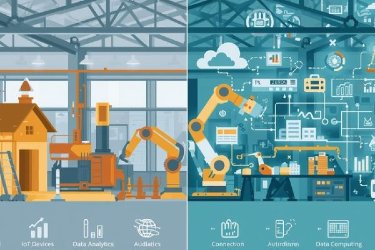 Across Asia, Africa, Latin America, and Eastern Europe, manufacturers adopting selective Industry 4.0 practices are seeing 10–25% efficiency gains, stronger export readiness, and improved resilience against global supply shocks.
Crucially, these gains are not coming from full-scale digitisation, but from targeted modernization aligned to local realities.
What makes this moment pivotal is that emerging-market manufacturers now face a dual pressure: rising global quality expectations and intense cost sensitivity at home.
Industry 4.0, when applied pragmatically, helps bridge this gap—allowing traditional factories to meet global standards without losing their cost advantage.
What Industry 4.0 Actually Means—Without the Jargon
For traditional manufacturers, Industry 4.0 is not about replacing machines or rebuilding factories. It is about connecting what already exists—machines, people, processes—into a system that can see, learn, and respond.
At its core, Industry 4.0 enables:
• Real-time visibility across production
• Data-driven decision-making on the shop floor
• Predictive rather than reactive operations
This shift turns experience-based manufacturing into evidence-led manufacturing.
Why Emerging Markets Are Uniquely Positioned
Contrary to popular belief, manufacturers in emerging markets have three advantages:
1. Flexible production structures with fewer rigid legacy systems
2. Skilled human capital that adapts quickly when empowered with tools
3. Cost-efficient scaling, making incremental upgrades viable
These conditions make Industry 4.0 adoption faster and more economical than in many developed markets.
Practical Industry 4.0 Applications That Are Working Today
1. Machine Connectivity & Performance Monitoring
Low-cost sensors and cloud dashboards track uptime, efficiency, and anomalies.
Outcome: Reduced downtime without expensive overhauls.
2. Digital Quality Traceability
Manufacturers track materials, batches, and outputs digitally, improving accountability.
Outcome: Easier compliance with global buyer requirements.
3. Predictive Maintenance
AI models forecast machine wear and maintenance needs.
Outcome: Fewer production disruptions and longer asset life.
4. Production Data Transparency
Operators and supervisors share real-time production metrics.
Outcome: Faster issue resolution and improved morale.
5. Energy & Resource Tracking
Digital monitoring highlights waste and inefficiencies.
Outcome: Lower costs and sustainability alignment.
The Cultural Shift That Matters More Than Technology
 Industry 4.0 succeeds when manufacturers shift from:
• “Fix it when it breaks” → “Prevent it before it slows us down”
• “Experience alone decides” → “Experience supported by data”
This mindset change often delivers more value than the technology itself.
Common Myths That Hold Firms Back
• “Industry 4.0 is too expensive” → Incremental adoption proves otherwise
• “Our workforce won’t adapt” → Adoption increases pride and ownership
• “We are too small” → Smaller scale enables faster experimentation
Manufacturers that move early are discovering that digital maturity compounds quickly.
The Strategic Reality for 2026
Global buyers are no longer asking, “Are you digital?”
They are asking, “Are you predictable, traceable, and scalable?”
Industry 4.0 is how traditional manufacturers in emerging markets answer that question—without losing their identity or economic edge.
Across Asia, Africa, Latin America, and Eastern Europe, manufacturers adopting selective Industry 4.0 practices are seeing 10–25% efficiency gains, stronger export readiness, and improved resilience against global supply shocks.Crucially, these gains are not coming from full-scale digitisation, but from targeted modernization aligned to local realities.
What makes this moment pivotal is that emerging-market manufacturers now face a dual pressure: rising global quality expectations and intense cost sensitivity at home.
Industry 4.0, when applied pragmatically, helps bridge this gap—allowing traditional factories to meet global standards without losing their cost advantage.
What Industry 4.0 Actually Means—Without the Jargon
For traditional manufacturers, Industry 4.0 is not about replacing machines or rebuilding factories. It is about connecting what already exists—machines, people, processes—into a system that can see, learn, and respond.
At its core, Industry 4.0 enables:
• Real-time visibility across production
• Data-driven decision-making on the shop floor
• Predictive rather than reactive operations
This shift turns experience-based manufacturing into evidence-led manufacturing.
Why Emerging Markets Are Uniquely Positioned
Contrary to popular belief, manufacturers in emerging markets have three advantages:
1. Flexible production structures with fewer rigid legacy systems
2. Skilled human capital that adapts quickly when empowered with tools
3. Cost-efficient scaling, making incremental upgrades viable
These conditions make Industry 4.0 adoption faster and more economical than in many developed markets.
Practical Industry 4.0 Applications That Are Working Today
1. Machine Connectivity & Performance Monitoring
Low-cost sensors and cloud dashboards track uptime, efficiency, and anomalies.
Outcome: Reduced downtime without expensive overhauls.
2. Digital Quality Traceability
Manufacturers track materials, batches, and outputs digitally, improving accountability.
Outcome: Easier compliance with global buyer requirements.
3. Predictive Maintenance
AI models forecast machine wear and maintenance needs.
Outcome: Fewer production disruptions and longer asset life.
4. Production Data Transparency
Operators and supervisors share real-time production metrics.
Outcome: Faster issue resolution and improved morale.
5. Energy & Resource Tracking
Digital monitoring highlights waste and inefficiencies.
Outcome: Lower costs and sustainability alignment.
The Cultural Shift That Matters More Than Technology
Industry 4.0 succeeds when manufacturers shift from:• “Fix it when it breaks” → “Prevent it before it slows us down”
• “Experience alone decides” → “Experience supported by data”
This mindset change often delivers more value than the technology itself.
Common Myths That Hold Firms Back
• “Industry 4.0 is too expensive” → Incremental adoption proves otherwise
• “Our workforce won’t adapt” → Adoption increases pride and ownership
• “We are too small” → Smaller scale enables faster experimentation
Manufacturers that move early are discovering that digital maturity compounds quickly.
The Strategic Reality for 2026
Global buyers are no longer asking, “Are you digital?”
They are asking, “Are you predictable, traceable, and scalable?”
Industry 4.0 is how traditional manufacturers in emerging markets answer that question—without losing their identity or economic edge.
Copyrights © 2026 Inspiration Unlimited - iU - Online Global Positivity Media
Any facts, figures or references stated here are made by the author & don't reflect the endorsement of iU at all times unless otherwise drafted by official staff at iU. A part [small/large] could be AI generated content at times and it's inevitable today. If you have a feedback particularly with regards to that, feel free to let us know. This article was first published here on 23rd January 2026.
Want to Publish About Your Business / Achievements
Get in TOUCH Right Away!

All chats are end-to-end encrypted by WhatsApp and won't be shared anywhere [won't be stored either].


Whether You're A Small Business, Startup or A Professional,
Give Your Brand A Powerful Digital Footprint
That's Loved by Search Engines & AI Engines Equally
For A Price That's Industry Best...☝