Tesla’s Robotaxi Vision in South Korea: A Glimpse Into a World Where Mobility Thinks for Itself

Seoul, South Korea
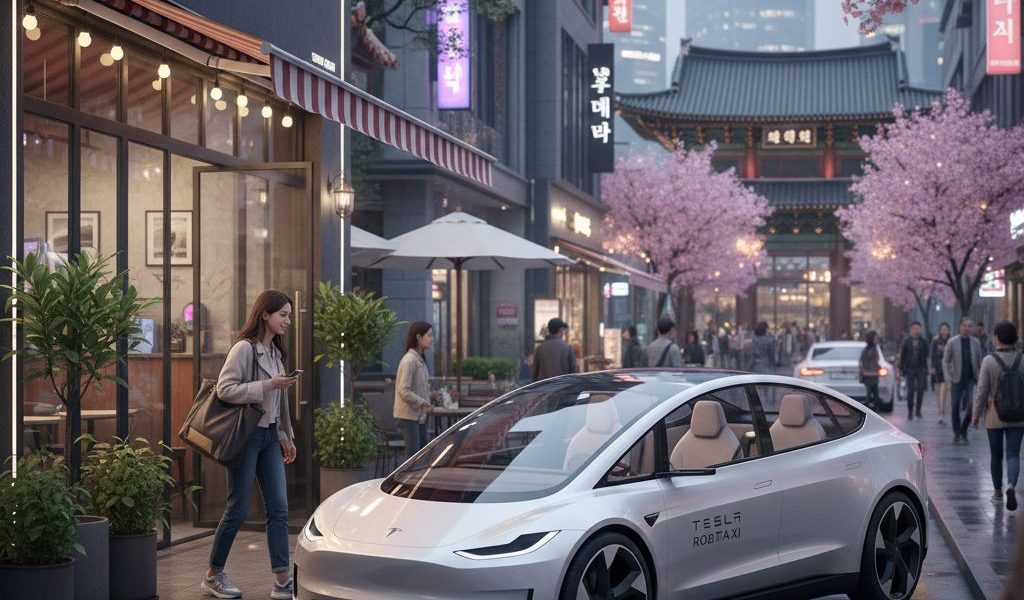
A quiet yet powerful shift is underway in global mobility, and it has just found its newest stage. With the vision of Tesla’s Robotaxi initiative in South Korea, the world is witnessing not just the rollout of autonomous vehicles, but the arrival of an entirely new philosophy of movement—one that blends artificial intelligence, sustainability, urban intelligence, and human convenience into a single living ecosystem.

For Inspiration Unlimited (iU), this moment represents more than a technological milestone. It marks a cultural inflection point—where cities, citizens, and machines begin to co-create the future. It is indeed a moment of unlimited inspiration. As kids we dreamt of a world where sci-fi was real to some extent and this is that world. Isn’t it?
Why South Korea? A Nation Built for the Future
South Korea has long been a laboratory for the future. From world-leading broadband infrastructure to smart cities, AI-driven governance, and a population deeply comfortable with technology, the country offers a uniquely fertile ground for autonomous mobility.
By choosing South Korea as one of the global launchpads for Robotaxi services, Tesla signals something important: the future of transportation will thrive where innovation, regulation, and societal readiness converge.
South Korea’s urban density, advanced traffic systems, and digitally connected citizens make it an ideal proving ground for self-driving fleets that learn, adapt, and improve at scale.
What Is Tesla’s Robotaxi—And Why It Matters
At its core, Tesla’s Robotaxi is not just a driverless car. It is a fully autonomous, AI-powered mobility service designed to function without human intervention—no steering wheel, no pedals, no driver. It represents Tesla’s vision of transportation as a service, not ownership.
But the implications go far deeper.
Robotaxis promise:
Reduced traffic congestion
Lower transportation costs
Fewer accidents caused by human error
Cleaner cities through electric-only fleets
Greater accessibility for the elderly and disabled
In essence, this is mobility reimagined as an intelligent public utility.
From Ownership to Access: A Paradigm Shift
For over a century, the automobile symbolized personal freedom through ownership. Tesla’s Robotaxi challenges that narrative.
In the Robotaxi era, freedom is not about owning a vehicle—it’s about access. Access to safe, affordable, on-demand mobility anytime, anywhere.
Imagine a Seoul where:
Cars rarely sit idle
Parking spaces are repurposed into green zones
Commute time becomes productive or restful time
Transportation adapts dynamically to city rhythms
This is not science fiction. This is the logical next step in urban evolution.
AI on Wheels: The Brain Behind the Journey
Tesla’s advantage lies in its vertically integrated approach to artificial intelligence. Every Robotaxi is powered by real-world driving data collected from millions of vehicles globally, continuously refined through machine learning.
Unlike rule-based automation, Tesla’s autonomous systems learn like humans—by observing, predicting, and adapting.
Each kilometer driven in South Korea will not just transport passengers—it will feed a global intelligence network, making every Robotaxi worldwide smarter, safer, and more efficient.
This is collective intelligence in motion.
Safety as a System, Not a Feature
One of the most compelling aspects of the Robotaxi vision is safety at scale.
Human drivers are prone to distraction, fatigue, emotion, and inconsistency. Autonomous systems, by contrast, operate with:
360-degree awareness
Millisecond reaction times
No impairment or emotional bias
As Robotaxis integrate into South Korean roads, they will coexist with human-driven vehicles, pedestrians, cyclists, and complex urban environments—learning not just traffic rules, but cultural driving patterns unique to the region.
Safety here is not promised as perfection, but as continuous improvement—an evolving system that gets better with every journey.
Economic Ripples: Redefining Work and Opportunity
The Robotaxi launch will inevitably reshape economic landscapes.
Traditional driving jobs may decline—but new opportunities will rise:
Autonomous fleet management
AI system monitoring
Urban mobility planning
Data analytics and optimization
Smart infrastructure development
South Korea’s strong emphasis on education, engineering, and technology positions it well to lead this transition, not resist it.
At iU, we believe progress is not about preserving old roles—but about creating more meaningful, future-ready ones.
Sustainability at the Core
Every Tesla Robotaxi is electric. That fact alone carries enormous implications for climate-conscious cities.
Transportation remains one of the largest contributors to urban emissions. Replacing millions of individual combustion vehicles with shared electric Robotaxis could:
Dramatically reduce carbon footprints
Improve air quality
Lower noise pollution
Accelerate the transition to renewable energy ecosystems
In cities like Seoul, where environmental responsibility and innovation often go hand in hand, Robotaxis could become a cornerstone of sustainable urban living.
Trust, Culture, and the Human Element
Technology does not succeed on capability alone—it succeeds on trust.
South Korea’s relationship with innovation is deeply cultural. From early adoption of smartphones to cashless economies and AI-powered services, trust in technology is earned through reliability and value.
Tesla’s Robotaxi journey in South Korea will not be defined by launch day—but by everyday experiences:
The first seamless ride
The first time a family trusts the system
The first city block transformed
These moments, small yet profound, will determine how quickly autonomy becomes normal.
A Global Signal, Not a Local Experiment
While this launch is geographically rooted in South Korea, its message is global.
It tells the world that:
Autonomous mobility is no longer experimental
Cities are ready to collaborate with AI
Citizens are prepared to rethink movement
The future is being deployed, not debated
Under the long-term vision championed by Elon Musk, Robotaxis are not just vehicles—they are nodes in a planetary transportation network.
South Korea is now one of those critical nodes.
Why This Matters to Inspiration Unlimited Readers
At Inspiration Unlimited, we track moments where technology meets human aspiration.
Tesla’s Robotaxi launch is not about cars.
It’s about:
Time reclaimed
Cities reimagined
Energy respected
Intelligence amplified
It invites us to ask deeper questions:
What happens when machines give us back time?
How do cities feel when movement becomes effortless?
What does freedom look like in an autonomous age?
The answers will define the next generation.
Looking Ahead
Today, Robotaxis begin with pilot zones, early adopters, and controlled environments.
Tomorrow, they become infrastructure.
And soon, they become invisible—quietly powering everyday life, just like electricity or the internet once did.
South Korea’s role in this journey will be remembered not merely as a host—but as a co-architect of a world where mobility is intelligent, inclusive, and sustainable.
Closing Thought
Every era has a defining transition.
For the industrial age, it was mechanization.
For the digital age, it was connectivity.
For the age we are entering now—it is autonomy with purpose.
Tesla’s Robotaxi launch in South Korea is not the end of a journey.
It is the beginning of a new way to move through the world.
And the road ahead has never looked more inspiring.
Recent Tesla Milestones in South Korea
FSD Official Launch (November 2023): Tesla officially launched Full Self-Driving (Supervised) in South Korea in late November 2025. This allows owners of Model 3, Model Y, Model S, and Model X to use the autonomous driving features on Korean roads for the first time.
Robotaxi App Unveiled (December 2025): Just this month, Tesla unveiled a dedicated Robotaxi app interface in South Korea. While you can’t hail a driverless Cybercab yet, this is a strategic move to prepare for a future “owner-sharing model” where Tesla owners can eventually add their cars to a ride-hailing network.
Regulatory Progress: The South Korean government has recently allowed FSD operations under the Korea-U.S. Free Trade Agreement (KORUS FTA), which removed previous import caps and paved the way for these software features.
When will the “Cybercab” actually arrive?
While testing of the specialized Cybercab (the one without a steering wheel or pedals) began in Austin, Texas in mid-2025, mass production is not scheduled to begin until April 2026. It will likely take some time after that for the specific vehicle to be deployed commercially in international markets like Seoul.