We often search for complicated fitness plans.
Interval systems. Hybrid routines. Gym memberships. Performance tracking apps. Biohacks.
And yet, one of the most sustainable and scientifically sound cardiovascular routines available to most people requires nothing more than a bicycle and thirty consistent minutes a day.

Cycling inside your apartment compound — unglamorous, simple, repetitive — may quietly be one of the most powerful long-term investments you can make in your body.
This is not motivational exaggeration. It is biomechanics and physiology.
Let’s walk through what actually happens inside you when you cycle for thirty minutes daily over ninety days.
The Biomechanics of Why Cycling Works
When you pedal, your body moves in a smooth circular pattern that activates major lower-body muscle groups — the quadriceps in the front of your thighs, the hamstrings behind them, your gluteus maximus, calves, hip flexors, and even your core stabilizers.
Unlike running, cycling produces very low joint impact. The knee moves through a lubricated, circular motion that promotes synovial fluid circulation rather than pounding stress. Because the movement is closed-chain and cyclical, there is minimal eccentric muscle damage — which means less soreness and faster recovery compared to many gym-based workouts.
This makes cycling remarkably sustainable. It strengthens the muscles that protect your knees while reducing overall joint loading. That’s why many physiotherapists recommend it not only for fitness but also for rehabilitation.
You are not just burning calories. You are building structural resilience.
What Happens to Your Heart Over 90 Days
Your heart is a muscle. And like any muscle, it adapts to repeated, moderate demand.
When you cycle consistently:
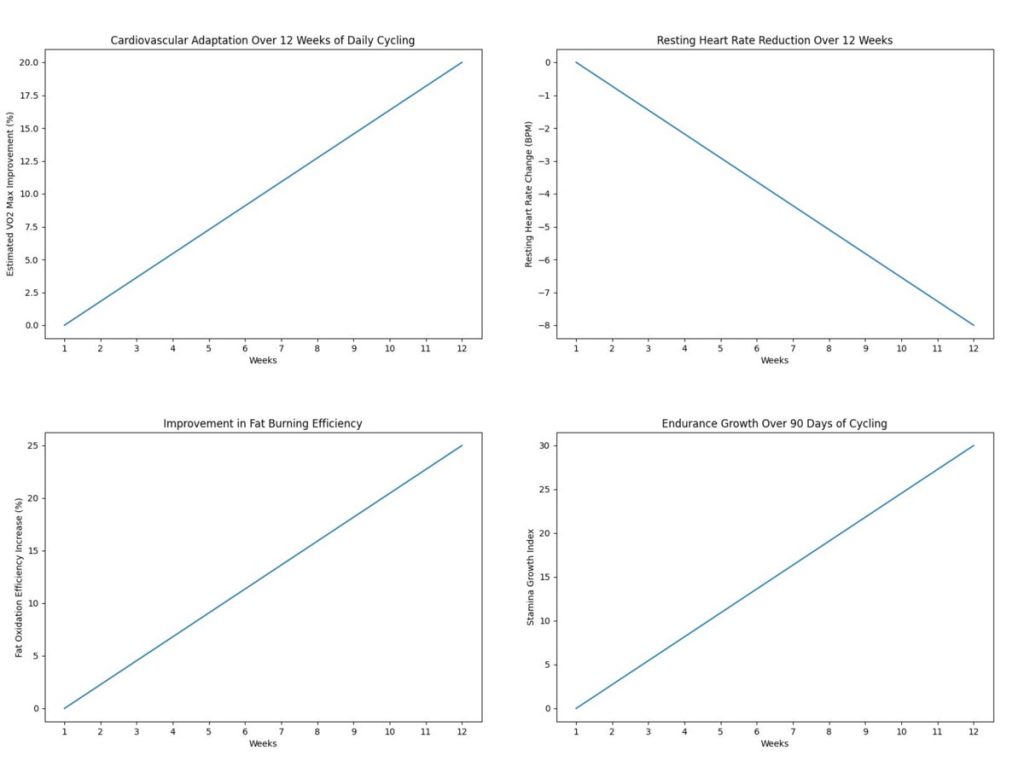
Your stroke volume increases — meaning your heart pumps more blood per beat.
Your resting heart rate gradually drops.
Your VO₂ max improves, allowing better oxygen utilization.
Your blood vessels become more elastic.
Blood sugar regulation improves.
Your body becomes better at burning fat for fuel.
These changes do not happen overnight. They unfold gradually, week by week.

Weeks 1–2: Your Nervous System Learns Efficiency
In the first two weeks, you may feel mild muscle soreness. Your legs might feel heavy. You might get slightly breathless even at moderate speeds.
Internally, your nervous system is learning how to pedal more efficiently. Motor coordination improves. Blood flow to working muscles increases. Your body begins laying the groundwork for cardiovascular adaptation.
Visible changes at this stage are minimal. But subtle improvements in mood and energy often appear early. Movement itself begins shifting your hormonal environment.
Weeks 3–4: Building the Cardiovascular Foundation
By the third and fourth weeks, something changes.
You recover faster after rides. You feel less drained. Sleep often improves. Your breathing feels more controlled.
Physiologically, aerobic efficiency can improve by five to ten percent in this period. Resting heart rate may drop by three to five beats per minute. Mitochondrial density — the energy factories inside your cells — begins increasing.
This is the phase where fat metabolism becomes more efficient. Your body learns to rely less on quick carbohydrates and more on stored fat for fuel.
Weeks 5–6: The Metabolic Shift
Around the sixth week, visible changes may begin.
Clothes might feel slightly looser. Stamina improves noticeably. You sweat more efficiently. Your endurance stabilizes.
Internally, insulin sensitivity improves. Your muscles become more efficient at using both glucose and fat. Endurance fibers adapt and strengthen.
If your diet is reasonably balanced, this is where fat loss often becomes measurable. Not dramatic — but visible.
Weeks 7–8: Structural Adaptation
By this stage, cycling begins to feel easier.
Your thighs feel firmer. Glutes become stronger. Core stability subtly improves. You may find yourself increasing speed or resistance without consciously trying.
Biologically, capillary density increases — allowing more oxygen delivery to muscles. Muscle fibers become more oxidative. Blood pressure may begin to reduce if previously elevated.
What once felt like effort now feels like rhythm.
Weeks 9–12: Performance and Body Composition
By the twelfth week, the adaptations consolidate.
VO₂ max significantly improves. Fat oxidation rates increase. Heart efficiency strengthens. Inflammation markers often decline.
You may notice improved leg tone, reduced abdominal fat if diet supports it, and more consistent daytime energy. Mental clarity often improves as well.
The body has now shifted from “adapting” to “thriving.”
This is where long-term health benefits begin locking in.
The Mental and Hormonal Effects
Physical adaptation is only half the story.
Regular cycling increases endorphin release. Dopamine regulation improves. Cortisol baseline levels tend to decline with consistent moderate cardiovascular training. Sleep cycles stabilize. Anxiety levels often reduce.
Beyond chemistry, discipline compounds.
When you show up daily for thirty minutes, your brain begins associating consistency with identity. You are no longer “trying” to be fit. You are someone who moves.
That psychological shift is powerful.
Will You Lose Weight?
Weight loss depends on intensity, diet, and current body composition.
A moderate thirty-minute ride typically burns between 200 and 350 calories. Over ninety days, with consistent effort and reasonable eating habits, many individuals may see a two to five kilogram fat reduction.
But the deeper benefit is metabolic health, not just scale numbers.
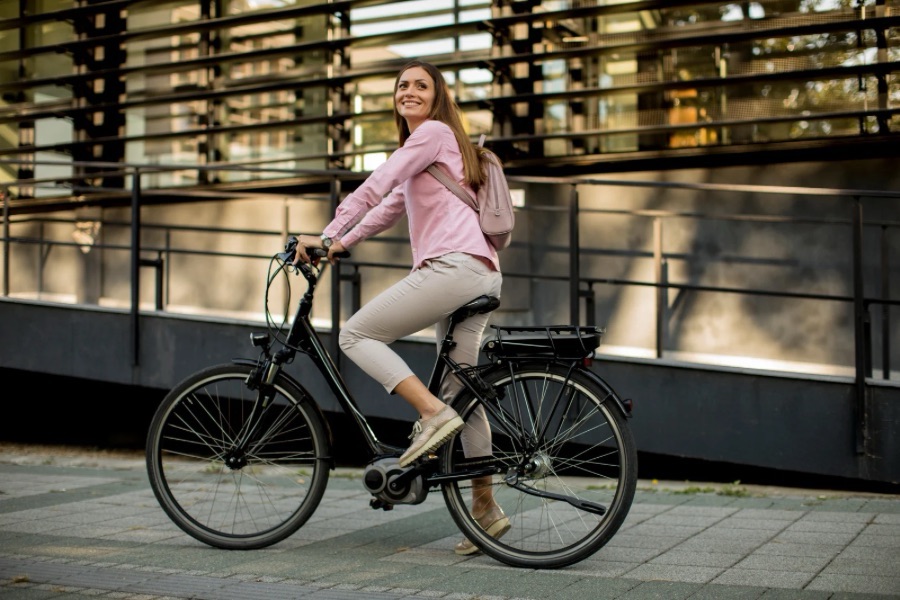
Cycling improves fat utilization even when you are resting. That shift outlasts the workout itself.
Injury Risk and Sustainability
Cycling carries low injury risk when done correctly.
Seat height should allow a slight knee bend at the bottom of the pedal stroke. Avoid pushing heavy gears in the early weeks. Warm up gently for three to five minutes before increasing intensity. Stretch quads and hamstrings afterward.
Because of its low impact nature, cycling is one of the safest long-term habits you can maintain into older age.
Miss one or two days a week? No problem.
Miss two weeks? Some adaptation declines, but recovery happens quickly once you resume.
Consistency matters more than perfection.
The Bigger Picture
The beauty of cycling daily is not just what it does to your legs or lungs.
It builds cardiovascular strength.
It protects joints.
It improves insulin sensitivity.
It supports fat loss.
It reduces stress.
It sharpens the mind.
It lowers long-term health risks.
And it does all this without demanding extreme intensity or complex routines.
In a world obsessed with shortcuts, this is one of the most reliable long-term “hacks” available.
Final Reflection
You will age.
But how you age is deeply influenced by what you do daily.
Thirty minutes of cycling inside your apartment compound may not look impressive. It won’t trend. It won’t draw applause.
But over ninety days, it will quietly reshape your cardiovascular system, metabolism, muscle structure, and mental resilience.
And over years, it may reshape your health trajectory entirely.
Sometimes, the simplest habits are the most powerful.