Some foods are eaten.
Some foods are remembered.
And then there are foods like jhalmuri — simple, unassuming, sold on streets and railway platforms — yet carrying within them stories of culture, community, and everyday life.
At first glance, it may look like just a mixture of puffed rice and spices.
But jhalmuri is far more than that.
It is movement.
It is rhythm.
It is India — in a paper cone.
What Exactly Is Jhalmuri?
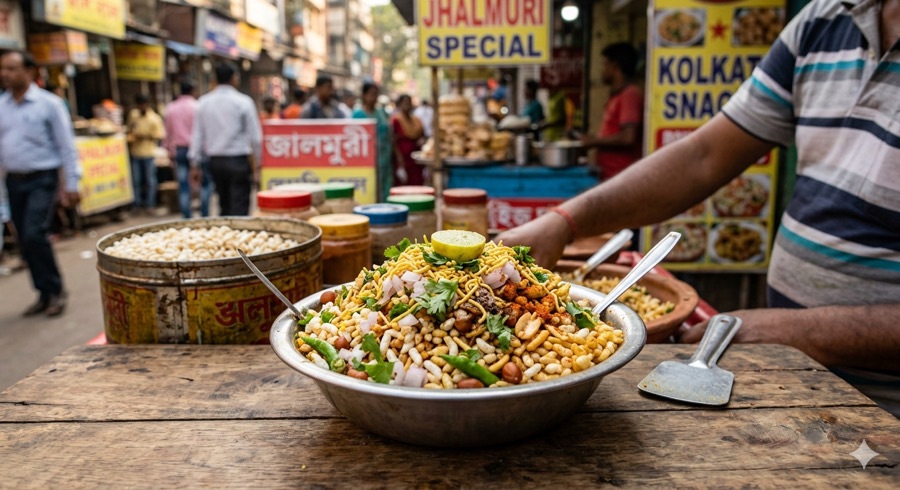
Jhalmuri is a popular street snack that originated in eastern India, especially in regions like West Bengal, Bihar, and parts of Odisha. The name itself gives away its character — “jhal” means spicy, and “muri” refers to puffed rice.
Together, it becomes a spicy puffed rice mix.
But calling it just that would be an understatement.
Jhalmuri is a carefully balanced medley of textures and flavors — crunchy, tangy, spicy, slightly sweet, and refreshingly light. It is designed not just to fill hunger, but to awaken the senses.
How Is Jhalmuri Made?
The beauty of jhalmuri lies in its immediacy.
It is not cooked hours before.
It is not stored in containers.
It is made fresh — right in front of you.
A typical preparation begins with puffed rice as the base. To this, the vendor adds finely chopped onions, green chilies, boiled potatoes, roasted peanuts, and sometimes tomatoes or coriander.
Then comes the magic.
A splash of mustard oil — sharp, aromatic, unmistakable.
A squeeze of fresh lemon.
A mix of spices — often including chaat masala, salt, and sometimes a special local blend.
A hint of tamarind chutney for tanginess.
Everything is tossed together rapidly in a metal container or bowl, mixed with practiced precision.
Within seconds, the ingredients transform.
What was separate becomes unified.
What was simple becomes vibrant.
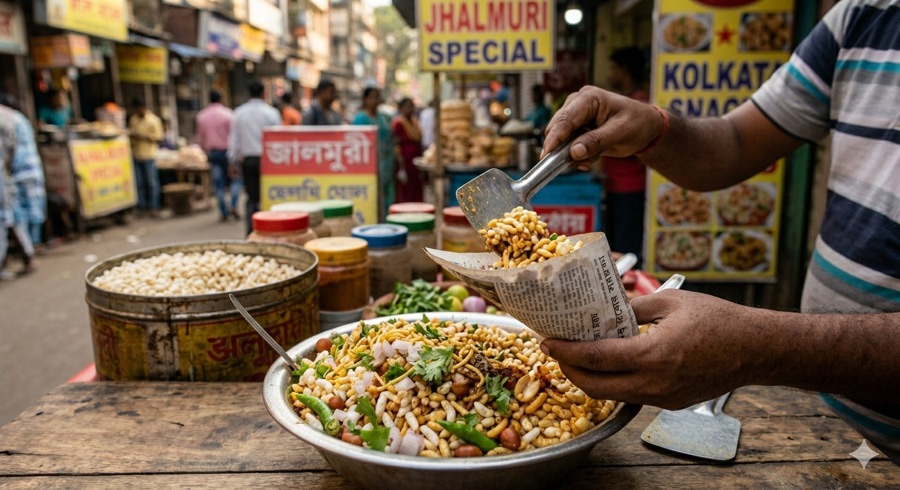
Served in a folded newspaper cone or a small bowl, jhalmuri is meant to be eaten immediately — while it still carries the freshness of its making.
Why Is Jhalmuri So Famous in India?
Its fame is not built through branding.
It is built through presence.
Jhalmuri is everywhere.
Railway stations.
Busy streets.
College campuses.
Evenings by the beach.
It belongs to the everyday life of millions.
One of the reasons for its popularity is accessibility. It is affordable, quick, and satisfying without being heavy. It fits into any moment — a quick snack between work, a conversation starter among friends, or a companion during long train journeys.
But beyond convenience, its appeal lies in its character.
Jhalmuri is interactive.
Every vendor has their own variation. Every region adds its own touch. Some make it spicier, some tangier, some richer with additional ingredients.
No two servings are exactly the same.
A Snack That Reflects Culture
Street food often reflects the personality of a place.
Jhalmuri reflects eastern India’s love for bold flavors, simplicity, and improvisation.
It is not rigid.
It adapts.
It evolves.
Much like the communities that enjoy it.
In Kolkata, for instance, jhalmuri is almost an identity. Walk through the streets, and you will hear the rhythmic sound of vendors mixing ingredients, calling out to passersby.
It is not just food.
It is an experience.
The Science Behind Its Popularity
There is also a subtle brilliance in how jhalmuri satisfies.
It is light, yet filling.
Puffed rice provides volume without heaviness. Peanuts add protein and crunch. Onions and spices stimulate appetite. Mustard oil enhances aroma, making the entire mixture more appealing.
It hits multiple sensory points at once — texture, taste, smell, and even sound, as the crunch adds to the experience.
In a way, jhalmuri is engineered for satisfaction.
Without ever being engineered.
From Streets to Global Curiosity
In recent years, jhalmuri has started gaining attention beyond India.
Food bloggers, travel enthusiasts, and global culinary explorers are discovering its charm. It represents something many modern food trends attempt to recreate — authenticity. After Sri Narendra Modi’s recent visit to an outlet in WB, selling Jhalmuri took internet by the storm giving 100Mn+ views on his reel, it had become a household name globally.
No artificial presentation.
No over-complication.
Just real ingredients, mixed fresh, served instantly.
In a world moving toward processed convenience, jhalmuri stands as a reminder of what fresh simplicity feels like.
More Than Just a Snack
What makes jhalmuri truly special is not its ingredients, but its place in people’s lives.
It is the snack shared during conversations.
The comfort food during travel.
The taste that reminds many of home.
It does not demand attention.
It quietly becomes a part of memory.
A Final Thought
In a time where food is often turned into content, jhalmuri remains experience.
It does not try to impress.
It does not try to innovate aggressively.
And yet, it endures.
Because sometimes, the most powerful things are the simplest.
Jhalmuri is not just a dish.
It is a feeling.
One that continues to travel through streets, generations, and stories — one paper cone at a time.