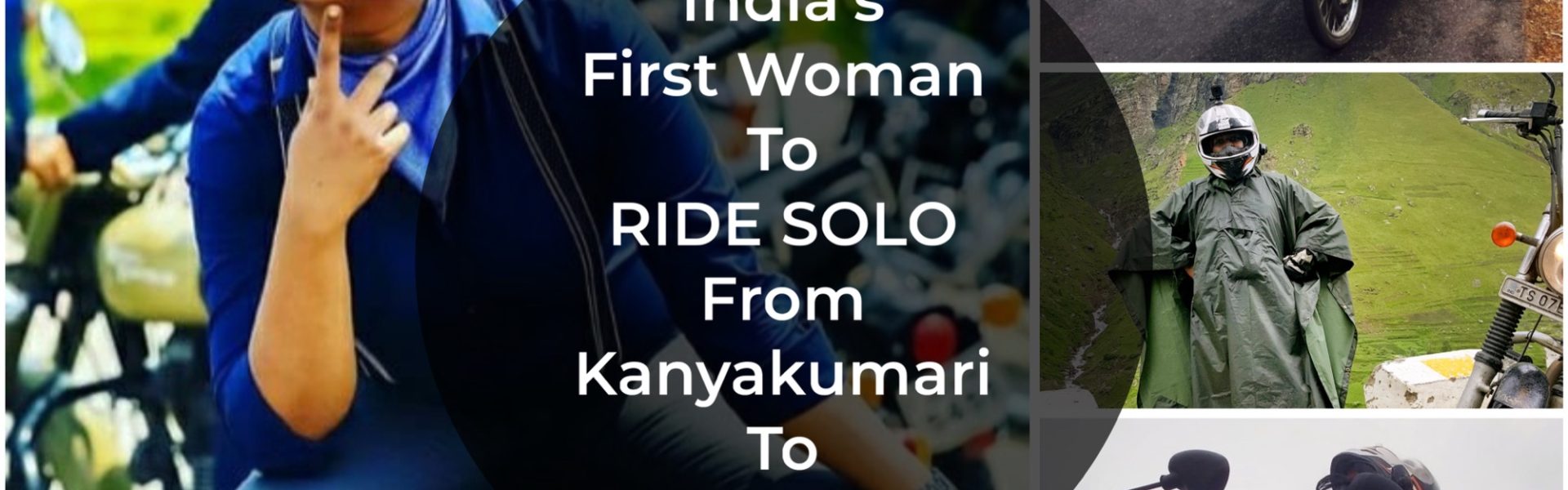
150,000 Kilometers of Courage: How Kiran Mortha Rode Solo Across India’s Toughest Roads — And Discovered the Psychology of Fearless Leadership

There are journeys measured in kilometers, and then there are journeys measured in courage. Kiran Mortha’s story belongs firmly in the latter.
Known as the first Indian woman to ride solo from Kanyakumari to Kashmir and onward to Khardung La, her path across India’s most unforgiving terrains is more than a tale of endurance on two wheels — it is a profound exploration of the psychology of courage itself.
Today, as an organisational psychologist and keynote speaker, Kiran brings the lessons forged on those lonely highways into boardrooms and leadership conversations around the world.
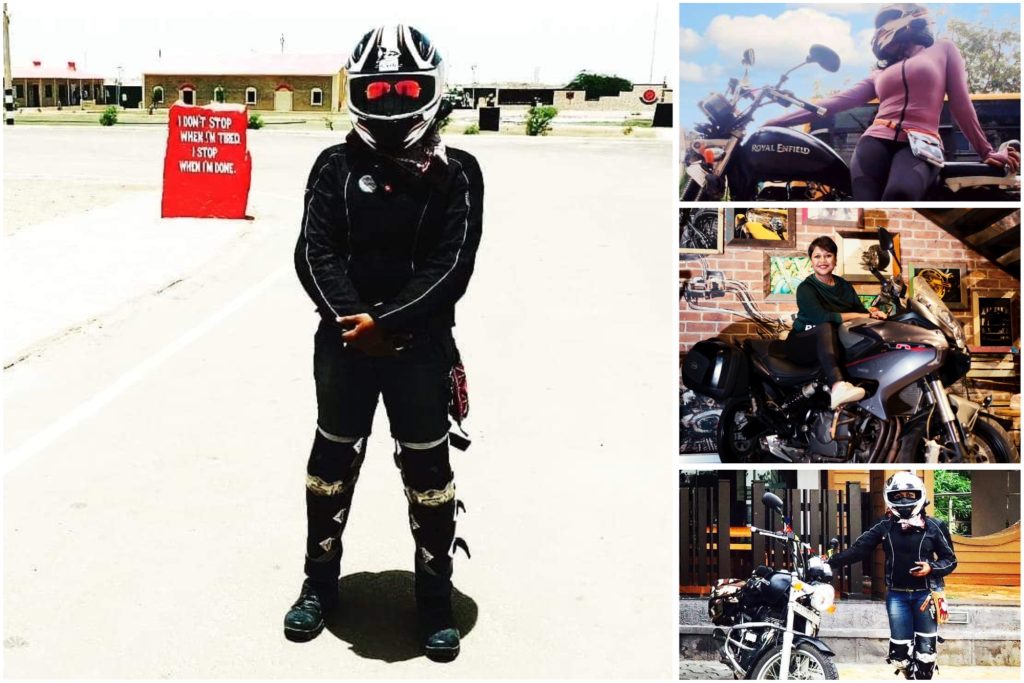
In this conversation, she reflects not just on the rides that made headlines, but on the deeper battles of fear, faith, solitude, and the internal discipline that shapes those who dare to move forward when others hesitate.
Below are grammatically refined versions of her answers while preserving her voice, flow, and intent. I have only corrected grammar, punctuation, and clarity — the meaning, tone, and structure remain intact.
1. Could you introduce yourself the way you want the world to know you today?
I am Kiran Mortha — an organisational psychologist and keynote speaker. I am also famously known for being the first Indian woman:
• to ride from Kanyakumari to Kashmir
• to ride solo to Khardung La.
But more than the miles, I want the world to know me as someone who understands the psychology of courage.
I do not speak about resilience as theory. I have lived it — through violence, survival, ambition, achievement, and silence.
I build leaders who do not collapse under pressure — because I have studied pressure from the inside.
2. What moment in your life transformed riding from a hobby into a calling?
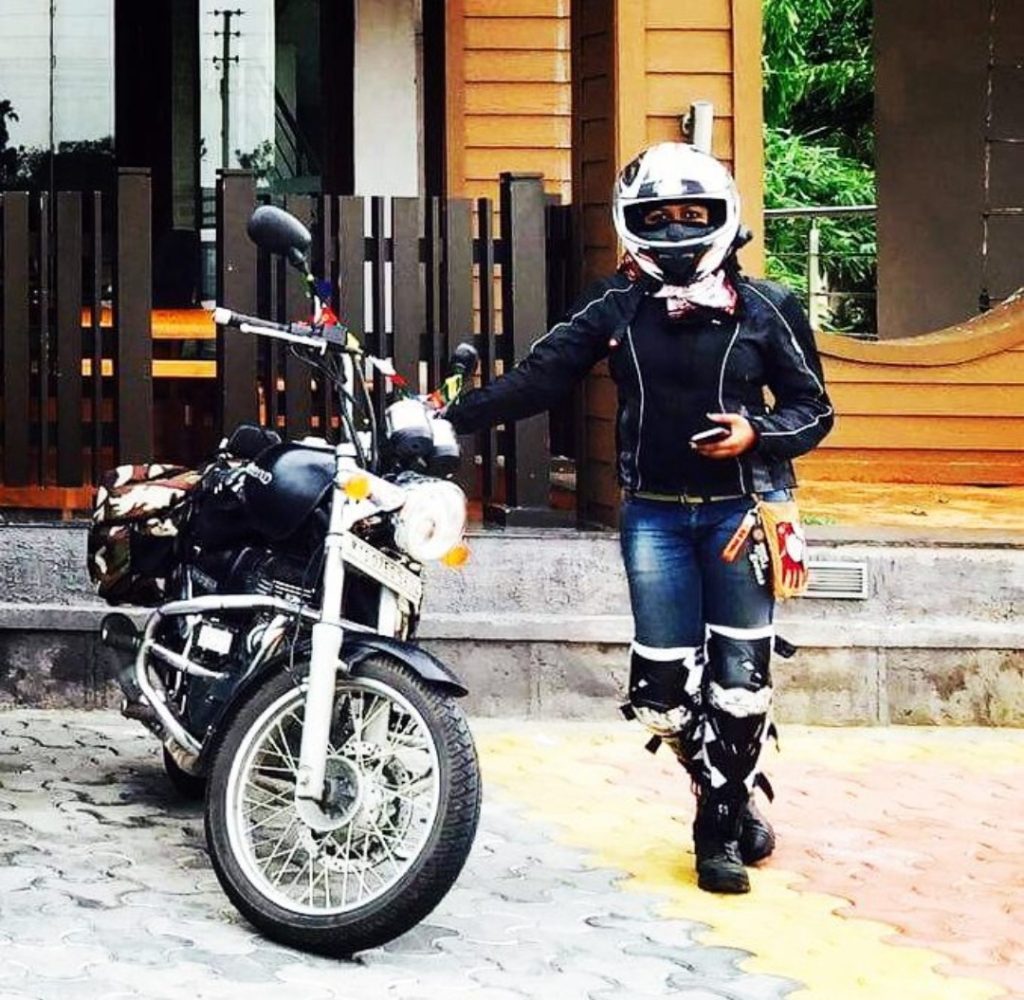
Riding was never a hobby for me. I learned to ride at the age of 16, and the first thought in my head was, “This makes sense.” And it remains so to this day.
That day, it became a calling.
I never knew I would grow up to set records in the biking arena. I just fell into its rhythm and rode forward — only forward.
Riding taught me sovereignty.
When I was alone on a highway with nothing but the sound of my engine, I met a version of myself that was complete and completely present.
3. Of the 150,000+ km you’ve ridden solo across India, which journey changed you the most — and how?
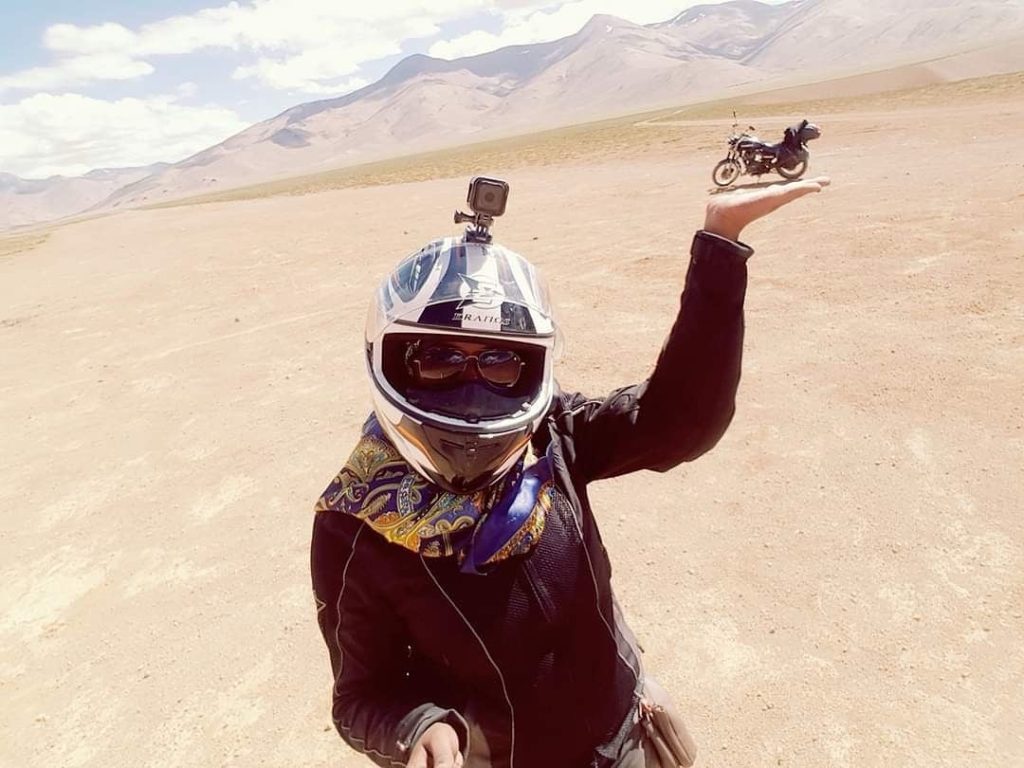
The stretch toward Ladakh changed me permanently.
Altitude strips you. Oxygen drops. Your mind slows. You suffer frostbite. The wilderness plays with your mind. A silly mistake can cost your life.
I was riding alone on some of the world’s most fatal roads, known for their kill count. And I was alone without a back-up van or any support, in regions where there is no network coverage. If I fall off a cliff, no one would even know.
It was there I understood the brilliance of a calm mind, emotional fortitude, a regulated nervous system, and about faith.
The mountains do not care about your gender, your trauma, or your ambition. They test you. They put you in life-or-death situations. They test your faith.
They respond only to clarity.
That journey taught me internal stillness under external chaos — a skill I now teach executives.
4. When you rode from Kanyakumari to Kashmir and onward to Khardung La alone, what was the single biggest internal battle you fought?
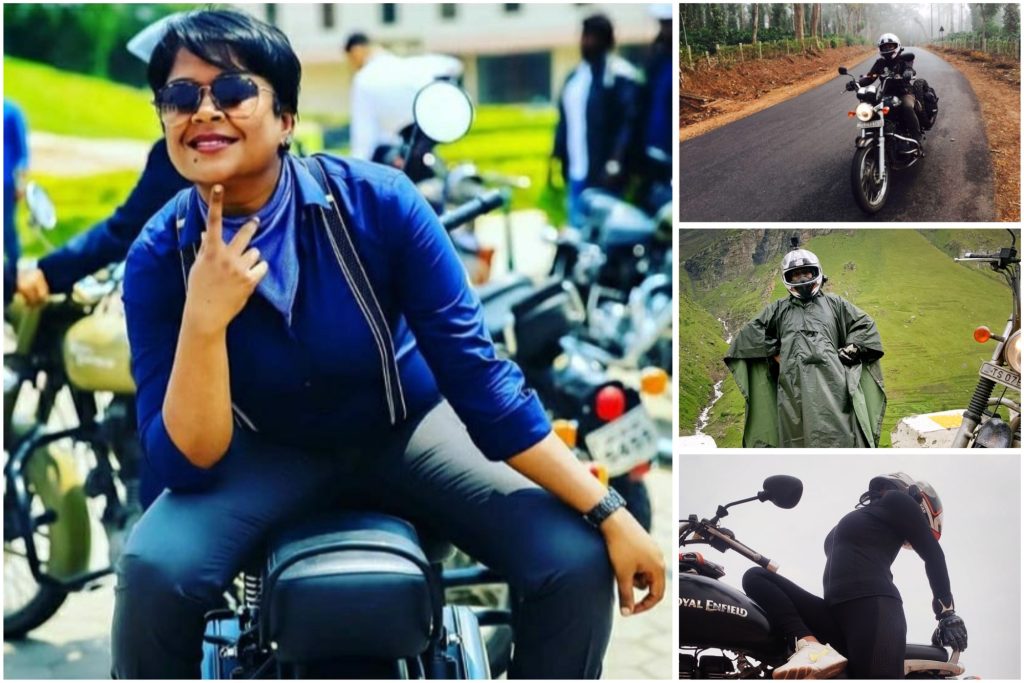
If you think the answer is “fear of death,” that would be the wrong answer. I was willing for it.
When someone said, “That’s very risky. You are inviting death,” my answer was, “That would be a great honour.” In fact, I donated my organs before I started the ride.
The point is, once I start my ride, I have no questions, no doubts, and no battles to fight.
It’s the road, my motorcycle, and me.
5. At the Army check-post in Ladakh, when you were told you were the first woman to complete that route solo, what did that realization awaken in you?
I never aimed to set a record. I never checked if someone had done it before me. In fact, the question did not even arise in my imagination. I did it because I wanted to.
For me, it was only one thought: “Ye hai, ye karna hai.”
When the officer at the check-post said I was the first, I did not feel triumph.
My first response was a shocked “What?” I asked myself, “This is 2018. Why could no woman in my country do it so far?”
I felt responsibility.
Looking at the bigger picture, of course there are challenges. Some can even cost your life. But if I could do it, it meant the barrier can be broken psychologically.
And that changes everything.
6. With no convoy, no backup, and no safety net, what systems — mental and practical — kept you steady on extreme terrain?
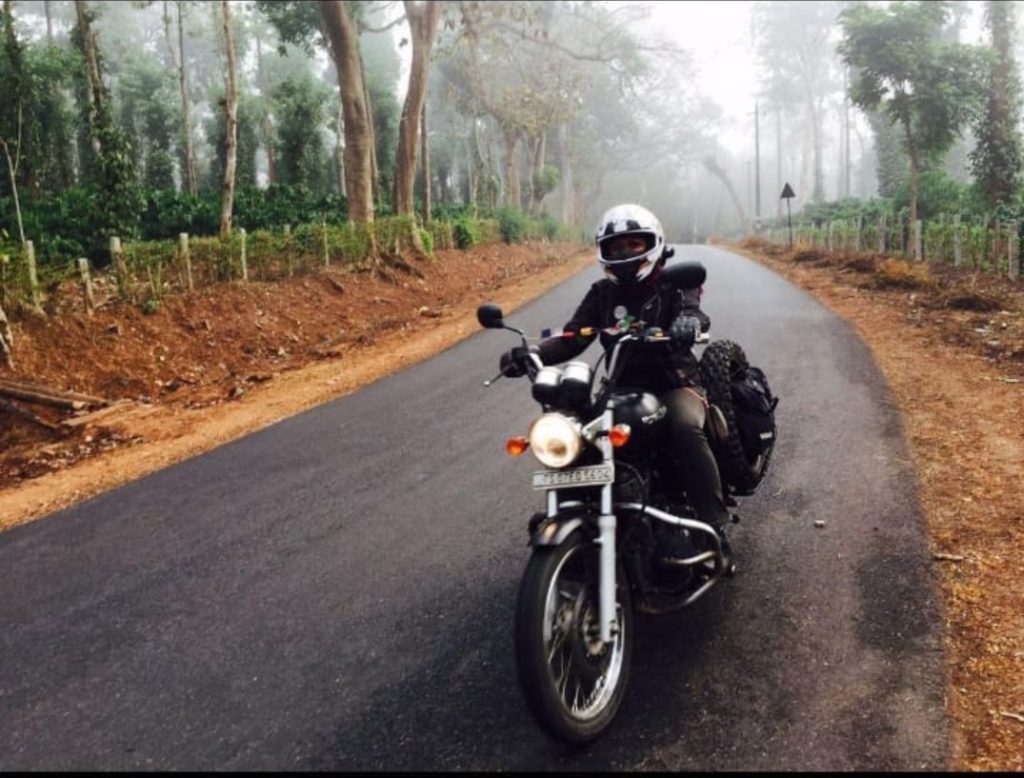
Three systems:
Emotional regulation —
Panic wastes oxygen. Calm preserves judgment. Micro-decisions.
Never think about the entire mountain. Think about the next 200 meters. Prepared solitude. Loneliness destabilises people who have never met themselves. I had done that work long before the ride.
Practically — machine checks, weather tracking, route intelligence, hydration discipline.
Mentally — no catastrophising, no ego riding, no proving.
And the romance of the whole thing. There is nothing more romantic in this world than nature in its true raw form. Sinking into it is a redemption of its own.
7. Was there a moment you almost stopped? What made you continue?
No.
The monsoon of Kerala, the terrains of Kishtwar, the heat of Pokhran, the cold of Drass — nothing deterred me.
8. You say the real question is not “how” you did it, but “why others didn’t dare.” What stops most people from taking bold action?
Things that stop people:
• Devotion
• Discipline
• Mental capacity
• Emotional toughness
• Social conditioning (predominant for women)
• Threat of attack (severe among women)
• Fear
• Isolation
• Discouragement by the immediate circle
• The very magnitude of the thought
9. As a psychologist, what have solo high-risk rides taught you about fear, isolation, and decision-making under pressure?
Fear is information, not instruction.
Isolation reveals your mental architecture. If your inner voice is hostile, solitude becomes torture.
Decision-making under pressure is not about intelligence — it is about nervous system regulation.
A dysregulated mind makes dramatic choices. A regulated one makes precise choices.
This understanding reshaped my life, its expanse, my expression, and hence my work in leadership psychology.
10. How has the road reshaped the way you guide leaders and executives in high-stakes environments?
On the road, hesitation can cost your life. In business, it can cost millions.
I train leaders to:
• Separate fear from data
• Act without emotional leakage
• Build internal authority
• Have the self-belief to act alone
• Be the fulcrum point and enjoy it, not succumb under its pressure
I do not coach from theory. I coach from terrain.
When I speak to a CXO about resilience, they know it is embodied.
11. What myth about women and courage does your journey directly dismantle?
The myth that courage in women must look gentle, supported, or supervised.
• Courage is not gendered
• Risk tolerance is not masculine
• Endurance is not male property
• Strength is human
• Mental toughness does not come from genitals
12. If you could leave readers with one challenge to step beyond their comfort zone, what would it be?
Do one thing this year that rearranges your self-image.
Not something impressive.
Something irreversible.
Because once you meet the version of you that does not retreat, you cannot go back to being small.
Reading what Kiran Mortha has to say for everything that iU asked her about her story, one can quickly realize that her story is not ultimately about motorcycles, mountains, or records.
It is about the quiet architecture of courage — the mental systems, emotional discipline, and clarity of purpose that allow a human being to move through uncertainty without shrinking from it.
Her rides across India’s harshest landscapes simply made visible what already existed within: a regulated mind, an unwavering sense of direction, and the willingness to meet oneself fully in solitude.
In a world where many wait for perfect conditions before taking bold steps, Kiran’s journey leaves us with a powerful invitation — not to replicate her miles, but to discover our own threshold of courage, and cross it.
If you are inspired by her story – share it with the woman you wish to see rise like her and let her know, her future/present self inspires you.
Note: The story is in the rider’s words and stated facts can only be directly checked with her. Get in touch with Kiran Mortha here.