
Create Helpful Content That Ranks: A Small Business Guide to Google’s E-E-A-T & Helpful Content Rules

For years, small businesses were told that ranking on Google was about keywords, backlinks, and technical tricks.
Today, that narrative has changed.
Search engines — and increasingly AI-driven discovery systems — are no longer asking “How well is this page optimized?” They are asking “How helpful is this content for a real person?”
That shift is good news for small businesses.
Because you may not have the biggest budget — but you have something far more valuable: real experience.
Why Google Changed the Rules (and Why Small Businesses Should Care)
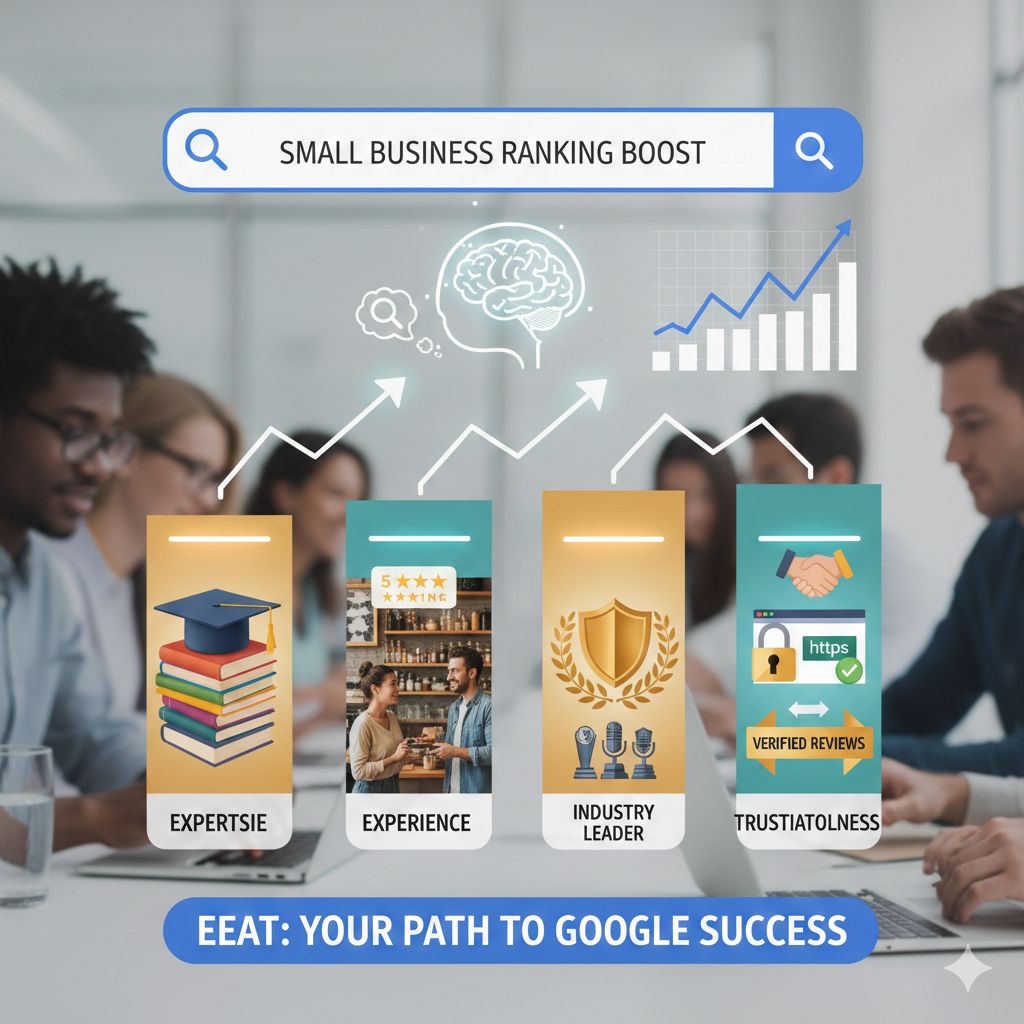
Google’s Helpful Content system and its E-E-A-T framework (Experience, Expertise, Authoritativeness, Trustworthiness) were introduced to reduce low-value, mass-produced content and reward genuine, experience-backed insight.
This means:
Generic content written “for SEO” is losing ground
First-hand knowledge is gaining visibility
Businesses that actually do the work have an edge
For small businesses, this levels the playing field. You don’t need a content factory.
You need clarity, honesty, and relevance.
Understanding E-E-A-T in Simple Terms
Let’s break it down without jargon.
Experience
Have you actually done what you’re writing about? A salon owner writing about hair care trends carries more weight than a generic article written by someone who has never worked with clients.
Expertise
Do you demonstrate knowledge through depth, examples, and explanations? Expertise is shown by how clearly you solve problems — not by fancy words.
Authoritativeness
Are you recognized — locally, socially, or professionally — for what you do?
Mentions, testimonials, case studies, and community presence all matter.
Trustworthiness
Is your content honest, accurate, transparent, and easy to verify?
Clear contact information, real names, and up-to-date content build trust.
Google is essentially rewarding content that feels human and dependable.
What “Helpful Content” Actually Means
Helpful content is not long for the sake of length.
It is content that:
Answers a real question clearly
Solves a specific problem
Is written for people, not algorithms
Leaves the reader more confident than before
If a visitor lands on your page and feels,
“This was written by someone who understands my situation”
— that’s helpful content.
And that’s exactly what Google wants to surface.
How Small Businesses Can Create Content That Truly Ranks
You don’t need 50 blog posts a month.
You need fewer, better ones.
Here’s how to approach it:
1. Write From the Shop Floor, Not the SEO Tool
Start with questions your customers ask you every week. Those questions are better than any keyword research.
2. Show Real Examples
Share before-after stories, mistakes you’ve seen, lessons you’ve learned, and outcomes you’ve delivered. This signals experience instantly.
3. Put a Real Name Behind the Content
Author bios matter.
When readers know who is speaking, trust increases — and so does search visibility.
4. Be Honest About Limitations
Content that admits “this won’t work for everyone” feels more trustworthy than exaggerated promises.
5. Update, Don’t Abandon
Refreshing existing content shows Google that your business is active and current — something AI models value highly.
Why Small Businesses Are Naturally Aligned With E-E-A-T
Large brands often rely on outsourced content written at scale. Small businesses write closer to the problem — and the people.
That proximity creates:
Authentic language
Local context
Practical advice
Real empathy
These are signals algorithms struggle to fake.
When you write about what you do every day, you automatically comply with E-E-A-T — without trying to “optimize” for it.
How Helpful Content Supports AI Search & GEO
AI systems summarise, recommend, and answer questions based on:
Clear structure
First-hand experience
Trust signals
Consistent messaging
Helpful content with strong E-E-A-T becomes easier for AI to:
Quote
Reference
Recommend
This is where blogs, guides, and explainers become discovery assets, not just SEO pages.
Small businesses that invest in clarity today are the ones AI will surface tomorrow.
Common Mistakes to Avoid
Writing for algorithms instead of people
Publishing thin content just to “stay active”
Copying competitor articles without adding insight
Hiding the author or business identity
Chasing every trend instead of your customer’s real needs
The goal is not to rank for everything.
The goal is to be useful for something specific.
Inspiration Unlimited Takeaway
Search engines are evolving — but their goal remains simple: help people find reliable answers.
Small businesses don’t need to fear these changes. They need to embrace them.
Your experience, your mistakes, your local knowledge, and your honesty are not weaknesses — they are ranking factors.
When you stop trying to “outsmart” Google and start trying to serve your audience, rankings follow naturally.
Because in the end, the most powerful SEO strategy has always been the same:
be genuinely helpful.