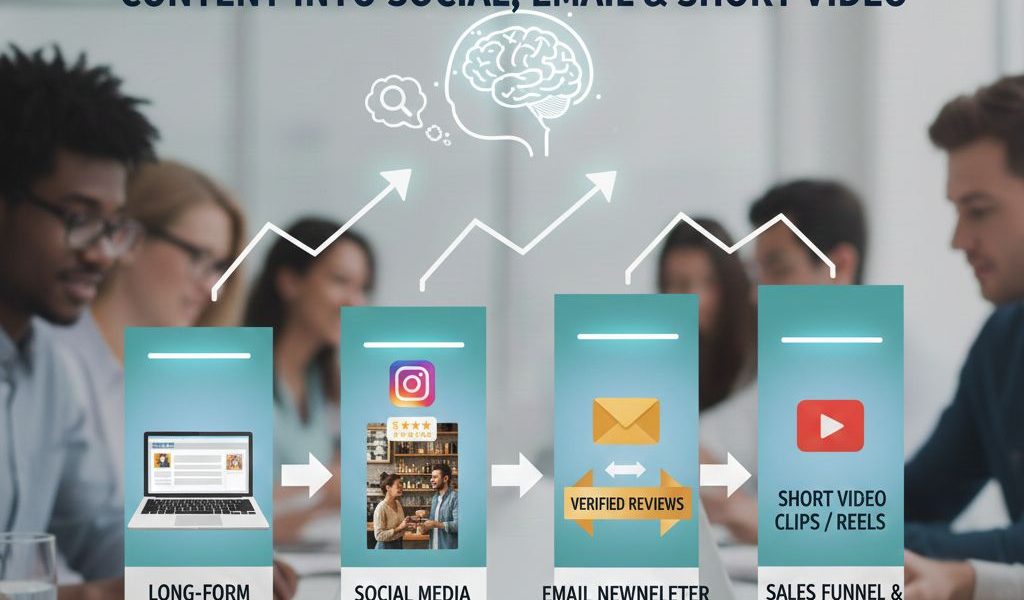
From Blog Post to Sales Funnel: How Small Businesses Can Repurpose Long-Form Content Into Social, Email & Short Video

For most small business owners, content marketing feels exhausting. You post on social media, send an occasional email, update your website once in a while — and still feel like you’re starting from zero every week.
The problem isn’t lack of effort.
It’s lack of structure.
Smart small businesses don’t create more content. They extract more value from what they already create.
And the best place to start is a single, well-written blog post.

Why One Blog Post Is Enough
A blog post is not just an article. It’s a core idea, a structured explanation, and a permanent asset you own.
Unlike social posts that disappear in hours, a blog:
Lives on your website
Builds search visibility
Establishes expertise
Can be reused endlessly
Think of your blog as the source, and every other platform as a distribution channel.
When you write one strong, experience-backed article, you’ve already done the hardest work — thinking clearly.
Step 1: Write Blogs That Are Meant to Be Repurposed
Not all blogs are equal.
Repurposable blogs have:
Clear sections and subheadings
Practical tips or steps
Real examples or stories
A clear takeaway
Avoid writing vague opinion pieces.
Instead, write problem-solving content — the kind your customers actually need.
For example:
“How a Local Gym Increased Membership Retention Without Discounts”
“What Most Small Retailers Get Wrong About Pricing”
These naturally break into smaller content pieces.
Step 2: Turn One Blog Into Social Media Content
A single blog can fuel weeks of social media.
Here’s how:
Extract 5–7 key insights and turn each into a standalone post
Convert statistics or lessons into quote graphics
Summarise sections into short LinkedIn or X (Twitter) threads
Ask one reflective question from the blog and post it as a poll or prompt
Instead of creating random posts, your social content now has depth and consistency — and all of it points back to your website.
This also builds authority. People start recognising your voice and perspective.
Step 3: Convert Blog Content Into Email Trust Builders
Email is where conversions happen.
But small businesses often underuse it.
Your blog makes email writing easy.
Use your article to create:
A short email introducing the problem
A second email sharing a real example
A third email offering a solution or resource
This sequence:
Educates
Builds trust
Softly leads to a product, service, or consultation
You’re not selling aggressively.
You’re guiding decisions.
And because the content already exists, consistency becomes manageable.
Step 4: Translate Ideas Into Short Videos
Short video doesn’t require high production.
It requires clarity.
From one blog, you can create:
3–5 short talking-head videos
One video per key insight
Simple captioned clips for Instagram, YouTube Shorts, or LinkedIn
Each video answers one question or shares one lesson — directly from your experience.
This works because people trust faces and voices, especially in local and service-based businesses.
Your blog gives structure.
Your presence gives credibility.

Step 5: Build a Simple Content Funnel
Here’s what a basic small-business content funnel looks like:
1. Blog post — depth and authority
2. Social posts — discovery and engagement
3. Email — trust and nurturing
4. Call to action — enquiry, booking, or purchase
Every piece points forward, not sideways.
Instead of shouting “buy now,” your content says: “Here’s how we think. If this resonates, let’s talk.”
That’s how trust converts.
Step 6: Measure What Actually Matters
You don’t need complex analytics.
Track:
Blog traffic and time on page
Social posts that drive clicks
Email replies or enquiries
Leads generated from content
If one blog drives multiple enquiries over months, it’s working — even if it doesn’t go viral.
Small businesses win through consistency and relevance, not scale.
Why This Approach Works Better Than Paid Ads Alone
Paid ads stop when budgets stop.
Repurposed content compounds.
Each blog becomes:
A search asset
A sales conversation starter
A credibility marker
A long-term lead generator
This approach also respects your time.
You focus on thinking once and distributing smartly, instead of constantly chasing new ideas.
Inspiration Unlimited Takeaway
Small businesses don’t need to outpost or outspend. They need to out-think and outlast.
When you treat a blog post as the beginning of a conversation — not the end — your content starts working together as a system.
One idea.
Many formats.
Consistent presence.
Compounding trust.
That’s not content marketing.
That’s business clarity in action.