

When the World Converged on India: The Inspiring Story of the AI Impact Summit 2026
In the heart of New Delhi’s Bharat Mandapam, something remarkable unfolded in February 2026 — not merely a conference, but a global reckoning with the future of intelligence, humanity, and technology. Over five days, the India AI Impact Summit 2026 became more than a gathering of thinkers and innovators; it emerged as a defining chapter in how the world chooses to steward the age of artificial intelligence.
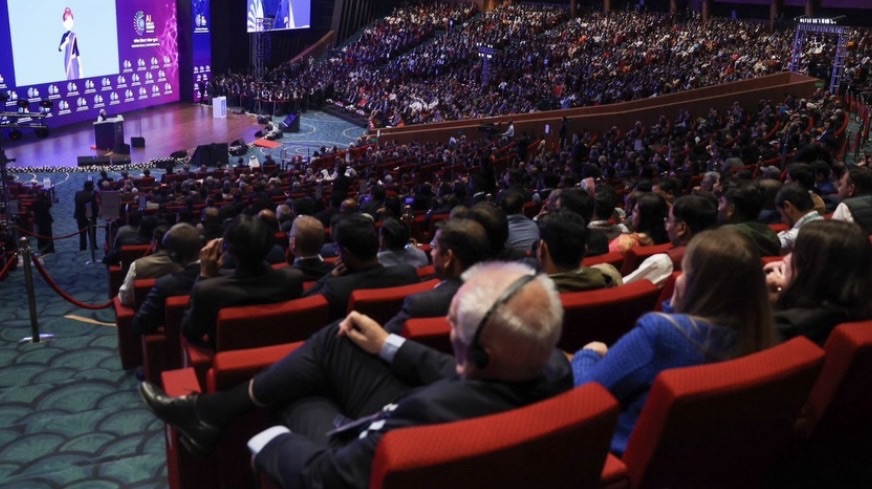
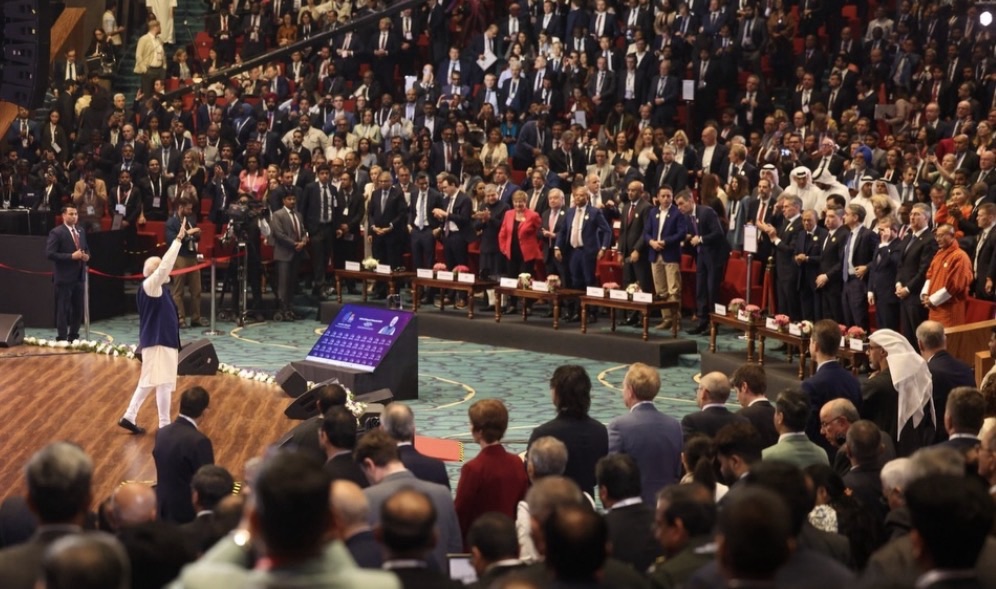
This was the first-ever global AI summit hosted by a nation from the Global South, bringing together over 20 heads of state, 60 ministers, and 500 global AI leaders to New Delhi under one roof.
Public institutions, private enterprises, startups, researchers and civil society converged in an unprecedented expression of collective imagination — all tasked with answering a simple yet profound question: How can humanity guide AI toward inclusive progress and shared prosperity?
What emerged over those days was not just a catalog of announcements, but a narrative of optimism, responsibility and collaborative ambition that will echo far beyond India’s borders.
From the opening moment, the Summit signalled a new mindset. Narendra Modi, inaugurating the Summit, spoke of a vision where “AI must be given an open sky, while command remains in human hands.” His words carved the philosophical foundation of the Summit — that technology, no matter how powerful, must remain aligned with human agency.
This idea was woven into every session, every panel, and every partnership announced over the following days.
A Summit Rooted in Purpose and Participation
What set this Summit apart was its sheer scale and inclusivity. It was not just an elite circle of technologists and policymakers, but a space where diverse voices met.
Companies from over 30 countries exhibited their work across more than 10 thematic pavilions, with over 300 exhibitors showcasing innovations in sectors ranging from health to agriculture to education.
This scope underscored a critical truth: AI is no longer confined to labs or corporate headquarters. Its influence — and its governance — must touch every field of human endeavor.
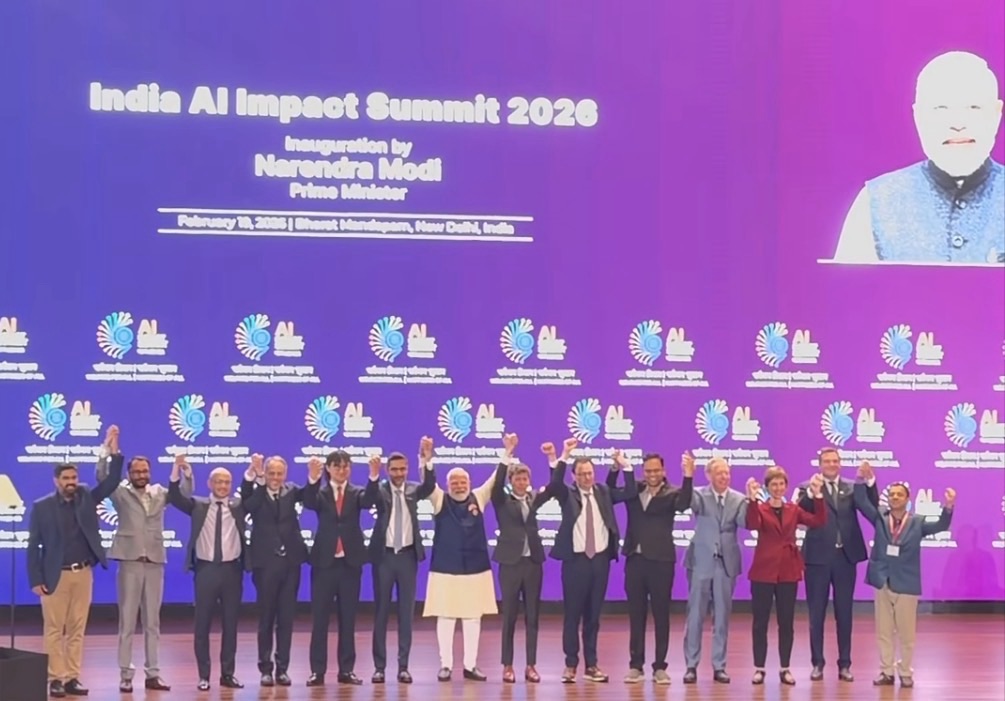
The Summit became a stage where India’s own AI ecosystem took centre stage, demonstrating how a nation with vast linguistic, cultural and geographic diversity can harness AI to serve people and communities, not just markets.
From Vision to Architecture: M.A.N.A.V and the Human-Centered Compass
Central to the Summit’s narrative was the unveiling of India’s M.A.N.A.V vision for AI — a framework that positions artificial intelligence as a tool for moral, ethical, inclusive and people-centric development. This vision rejected the idea that AI is an inevitability to be succumbed to, and instead presented it as a responsibility to be shaped.
Under M.A.N.A.V, AI is not merely a technology but a partner in progress — advancing education, expanding economic opportunity, enhancing healthcare, and empowering citizens with dignity and choice.
It was a narrative that resonated across cultures and continents, giving global leaders a shared lens through which to view AI not as a competitive weapon, but as a collective human asset.
Infrastructure Commitments: Building the Foundations of AI
One of the most concrete outcomes of the Summit was the reaffirmation of infrastructure commitments that will define India’s AI readiness for years.
In a bold announcement, India revealed plans to expand its computing infrastructure — more than 50,000 new Graphics Processing Units (GPUs) were to be deployed over the next six months, potentially bringing the nation’s total GPU capacity to over 100,000 units.
These high-performance units are the engines of AI development — powering model training, innovation pipelines and research experiments across academia and industry.
This wasn’t merely about hardware. It was a symbol: India was investing in its capacity to innovate, not just import technology.
From Commerce to Cognition: Breakthrough Announcements
If infrastructure laid the groundwork, the innovations unveiled during the Summit provided the glimpses of a future already breaking through.
Global companies stepped forward with commitments that underscored India’s increasing prominence as an AI hub. In a show of trust and scale, heavyweights like Reliance Industries and Adani Group announced massive investments — together pledging over $200 billion for AI infrastructure and data ecosystem development.
Microsoft reaffirmed its long-term commitment by outlining plans to invest $50 billion in the Global South by 2030, with India at its core.
These weren’t abstract commitments. They were long-horizon investments in data centres, AI-ready infrastructure, semiconductor-ready factories and partnerships that will shape markets and talent ecosystems for decades.
Among the highlights was a wave of breakthroughs that pointed to how AI will touch everyday life. Mastercard unveiled India’s first fully authenticated agentic commerce transaction, a system where an AI agent can autonomously search for a product, verify a merchant’s safety and complete a purchase — all without a user lifting a finger.
This signalled a future where AI is not just a tool but an active participant in commerce, reshaping convenience without sacrificing security.
Health and Data Sovereignty: A New Approach to Ethical AI
As central as excitement about AI’s capabilities was a keen focus on responsible use. The Summit showcased innovations that honoured privacy, ethics and data sovereignty.
At the intersection of healthcare and AI, India launched the Benchmarking Open Data Platform for Health (BODH) — a collaborative initiative under the Ayushman Bharat Digital Mission.
Unlike traditional models that expose sensitive data to external systems, BODH lets developers train and evaluate AI models using refined model weights rather than raw patient data, ensuring privacy is never sacrificed in the name of innovation.
This is the kind of development that transforms AI from a technical novelty to a trustworthy public good — where citizens can benefit without losing control of their own information.
Global Cooperation and Strategic Alliances
The Summit was as much about bridging borders as it was about building technologies.
A standout moment came as India formally joined the U.S.-led Pax Silica initiative, a strategic alliance designed to create secure supply chains in semiconductors, advanced manufacturing and critical technologies.
By aligning with partners from the U.S., Japan, U.K., and other democracies, India signalled its intent to lead not only in AI research but in shaping the geopolitics of technology and trust.
This was not a defensive move. It was a forward-looking embrace of collaboration, recognizing that AI’s impact on economies and societies cannot be contained within national borders.
At the same time, nations explored regional partnerships that went beyond headlines. A proposal floated for a Hyderabad–Jakarta Technology Skills Development Corridor between India and Indonesia.
Rather than insulating talent, this initiative seeks to cultivate shared capabilities across countries — nurturing the next generation of innovators, engineers and digital entrepreneurs.
Voices of Visionaries: Ideas That Stirred the Room
While data, investments and infrastructure framed the Summit’s structure, it was the words of its thought leaders that gave it soul.
Tech luminaries shared their visions for a world transformed by AI. One of the most attention-grabbing statements came from Sam Altman, who predicted that superintelligent AI — systems capable of outperforming humans in many forms of reasoning — might be just a few years away.
Yet his message did not dwell in fear. Rather, it emphasized caution, collaboration and collective governance — advocating for frameworks that ensure AI systems amplify human potential without concentrating power in a single entity.
Across the halls and pavilions, young innovators, students and entrepreneurs brought fresh energy. Stories circulated of AI startups from diverse regions, of local applications solving real problems in agriculture, education and climate resilience.
One young figure whose presence sparked conversation was Alexandr Wang, whose journey from college to AI leadership exemplified the generational shift AI is accelerating.
The Summit as Symbol: An Emerging Global Narrative
If there was a single, resonant theme at the AI Impact Summit 2026, it was this:
AI is not a future threat. It is a present opportunity — one that demands responsibility as much as ingenuity.
This message was not delivered in isolated speeches, but in investments, policy dialogues, partnerships, and technologies that honoured both innovation and ethics.
The Summit did not pretend to have all answers. But it modelled something rarer: a willingness to ask the right questions together.
How do we ensure AI is inclusive, not exclusionary?
How do we protect privacy while enabling progress?
How do nations compete without fragmenting cooperation?
How do we prepare workforces for transformation rather than displacement?
These questions, emerging from New Delhi, now echo across capitals, boardrooms and innovation labs around the world.
References
Coverage and analysis of the India AI Impact Summit 2026 inaugural and sessions with global leaders
Reports on investments and infrastructure announcements from major tech and industrial firms
Expansion of India’s AI computing capabilities via GPU commitments
Unveiling of innovative applications such as agentic commerce transactions
Launch of the Benchmarking Open Data Platform for Health
Global strategic cooperation initiatives such as Pax Silica signing and technology corridors
Statements and predictions from global AI leaders including Sam Altman and Nandan Nilekani


