
The Deep End of the Market: Where Opportunity Meets Extreme Risk
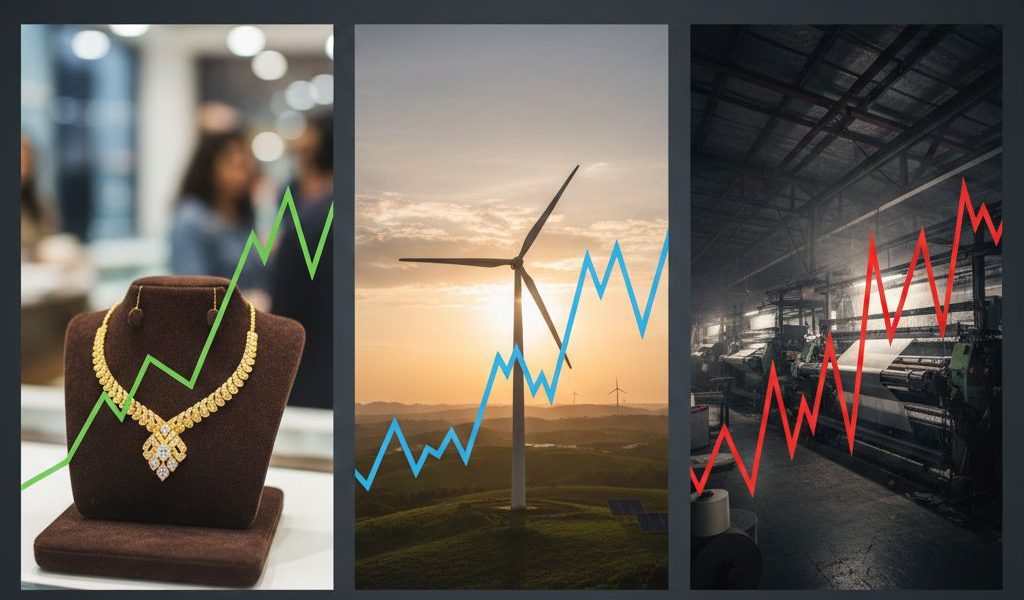
The stock market’s segment priced below ₹20 per share, often loosely termed the domain of micro-caps or penny stocks, is a world defined by paradox. It is where the dreams of astronomical returns meet the cold reality of significant financial distress. Investors entering this zone are not merely buying a stock; they are buying a narrative—a story of turnaround, disruptive growth, or sector-specific revival. To illustrate the profound differences in risk and reward within this volatile bracket, we examine three companies with starkly contrasting financial foundations and market opportunities: Motisons Jewellers, Orient Green Power Company Ltd., and Alok Industries Ltd.
The central challenge in evaluating these low-priced stocks is differentiating a low-priced gem from a structurally weak business. The price point itself is irrelevant; the underlying financial health and the integrity of the business model are everything.
Motisons Jewellers: The Narrative of Stable Consumer Growth
Motisons Jewellers represents the clearest example of a fundamentally sound, growing business within this high-risk segment. As a recent entrant to the listed space, this jewellery retailer, primarily focused in Rajasthan, offers a bet on the burgeoning Indian consumer story.
The financial health of Motisons stands out sharply against its peers in the sub-₹20 club. Unlike many micro-caps struggling with crippling leverage, Motisons maintains a low and decreasing Debt-to-Equity (D/E) ratio, typically hovering between 0.20 and 0.34. This low debt burden signifies a strong, manageable capital structure and significantly lower financial risk. Crucially, the company has demonstrated a track record of consistent and growing Net Profit (PAT), proving its business model is both viable and scalable in the organized retail sector.
The opportunity here is straightforward: it is a structural play on the massive shift from unorganized to organized jewellery retail in India, driven by increasing consumer trust, branding, and formalization. The primary risk is not business failure, but the inherent volatility and lack of liquidity often associated with small-cap, newly listed entities.
Orient Green Power: The Narrative of Deleveraging and Sectoral Transition
Orient Green Power (OGP) presents a classic example of a deleveraging turnaround story deeply entwined with a crucial national priority: the transition to renewable energy. OGP is primarily involved in operating wind energy farms, positioning it directly within India’s aggressive push toward green power.
Financially, OGP’s journey has been one of extreme self-correction. Historically burdened by high debt, the company has made significant strides in cleaning up its balance sheet. Its D/E ratio has plummeted dramatically over the past few years, moving from levels around 2.90 to a much healthier low-to-moderate range (approximately 0.05 to 0.50). This effort reflects a successful strategic focus on debt reduction and structural reorganization.
However, the path to sustained profitability remains inconsistent. While the debt is largely contained, the Net Profit (PAT) remains volatile, showing a mix of profit and loss due to the inherent nature of the power sector—fluctuations in wind patterns, regulatory shifts, and the terms of Power Purchase Agreements (PPAs) introduce unpredictability. The investment case here is a bet on the macro trend of green energy growth and the company’s ability to maintain its lean balance sheet while successfully expanding its operational capacity. It’s a risk tied to sectoral and regulatory headwinds rather than core business solvency.
Alok Industries: The Narrative of the High-Stakes Corporate Turnaround
Alok Industries offers the most high-risk, high-reward proposition of the three. It is not a story of growth or even steady operation, but one of a distressed asset turnaround under the new management of the Reliance Group, following its resolution through the Insolvency and Bankruptcy Code (IBC). Alok is a massive, vertically integrated textile manufacturer.
The company’s financial state is the weakest and most challenging. It operates with a state of Negative Net Worth, meaning its total liabilities exceed its total assets. This is clearly reflected in its consistently negative Debt-to-Equity ratio (e.g., -1.26) and its persistent, large Net Losses (Negative PAT). Investing in Alok is fundamentally a bet against its past financial history and a pure leap of faith into its future potential.
The opportunity is entirely predicated on two factors: the massive scale of its manufacturing assets and the execution capability of its powerful new promoters. Investors are speculating that the new management can successfully restructure operations, infuse necessary capital, modernize the textile infrastructure, and eventually drive the company back to cash-flow positive and profitable status.
This is not a gradual investment; it is a speculative, long-term proposition whose success is binary—either a complete failure or a spectacular multi-bagger if the turnaround materializes. The time horizon for any meaningful recovery is exceptionally long and the risks of further equity dilution or sustained losses are profound.
Synthesis: Defining the “Brightest” Prospect by Financial Merit
When evaluating these three contrasting narratives for a “bright future,” a crucial distinction must be made between financial stability and speculative potential.
- Motisons Jewellers is the brightest prospect based on current financial merit. It is a profitable, low-debt company whose core business benefits from a strong secular trend (organized retail). Its risk is primarily market-related, not existential.
- Orient Green Power is a moderate-risk turnaround. It has fixed its most serious structural flaw (debt) and offers exposure to a high-growth sector (renewables). Its future depends on operational efficiency and regulatory stability.
- Alok Industries is the least certain and most high-risk. Its future relies entirely on an operational rescue. While the reward could be massive due to its scale and new ownership, its chronic history of large losses and negative net worth means it remains firmly in the realm of highly speculative investment.
Ultimately, the choice among these three distinct small-cap opportunities is a reflection of the investor’s tolerance for risk: from the fundamentally stable growth story (Motisons) to the extreme operational overhaul gamble (Alok Industries).
Each stock represents a unique slice of the Indian market’s complex structure, proving that the price tag of ₹20 tells only a fraction of the full story.
Disclaimer: This is NOT investment advice. All three stocks operate in the high-risk, high-volatility micro/small-cap segment. The information is based on the latest available financial data (mostly Mar 2025/Sep 2025) and should be used only for educational comparison.