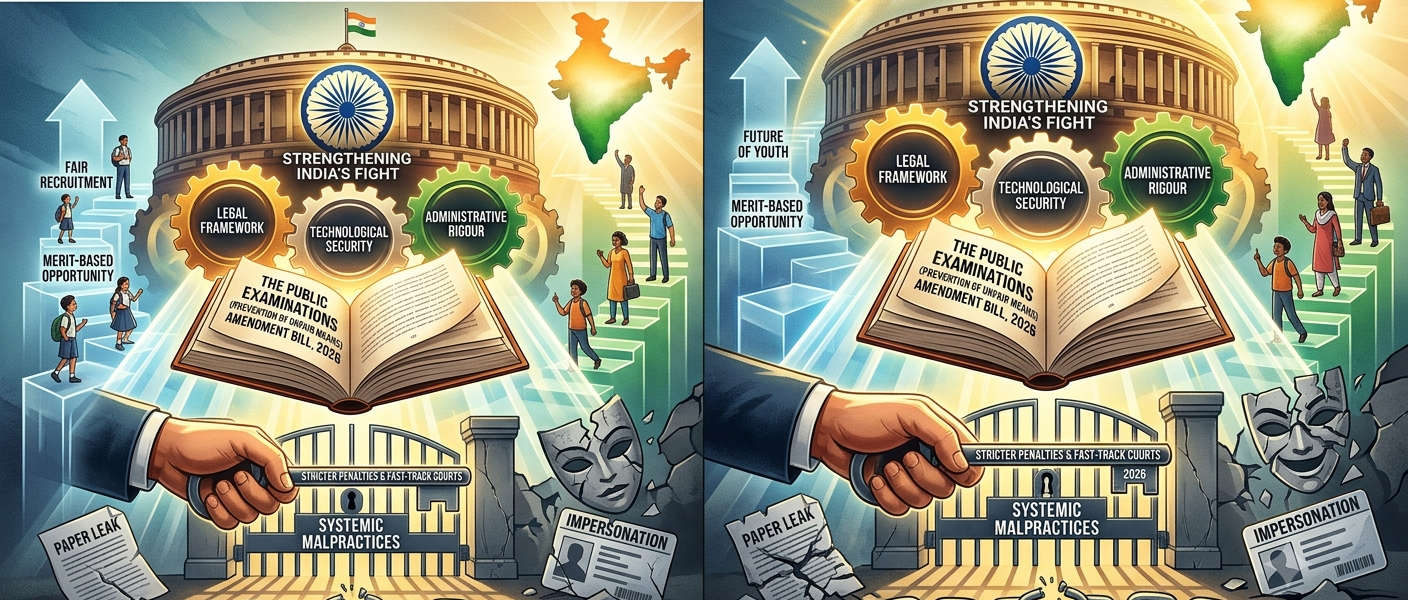
The Public Examinations (Prevention of Unfair Means) Amendment Bill, 2026: Strengthening India’s Fight Against Exam Malpractices

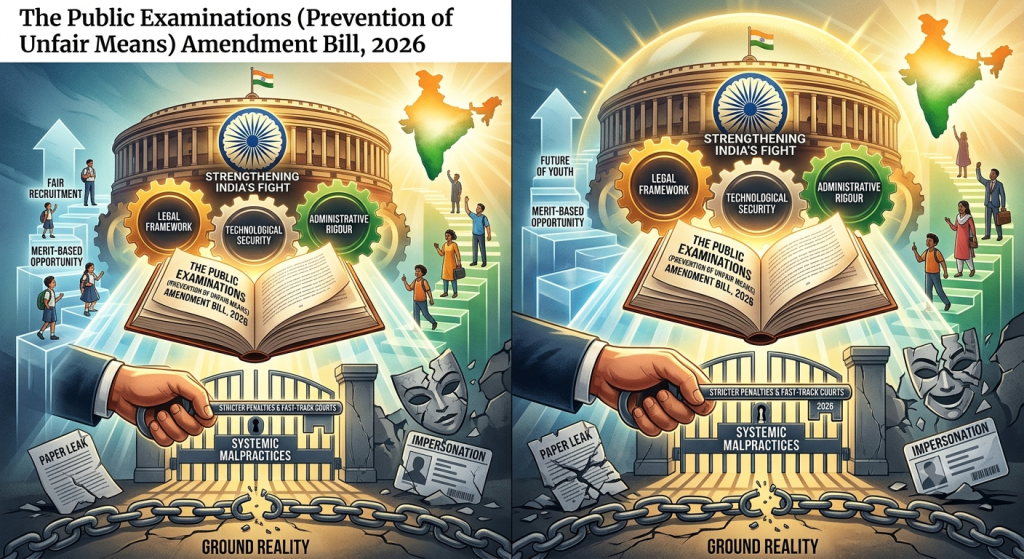
The legislation seeks to amend the Public Examinations (Prevention of Unfair Means) Act, 2024, by imposing significantly tougher penalties, mandating time-bound investigations and trials, and creating specialised institutional mechanisms to combat paper leaks, organised cheating networks, and other forms of unfair means in public examinations.
The introduction came against the backdrop of widespread student protests triggered by irregularities in the NEET-UG 2026 examination.
The medical entrance test, held on May 3, 2026, was cancelled following confirmed paper leaks, forcing a re-test for more than two million aspirants. The controversy escalated into nationwide demonstrations, allegations of police excesses during a July 20 “Sansad Chalo” protest at Jantar Mantar, and intense political pressure.
On July 25, Union Education Minister Dharmendra Pradhan resigned, taking moral responsibility—the first such resignation of a Modi government minister under sustained public pressure in over a decade. The government also constituted a high-powered task force headed by Nandan Nilekani to recommend systemic reforms in the examination ecosystem.
The original 2024 Act was itself a response to repeated paper leaks and malpractices that had disrupted recruitment and entrance examinations conducted by bodies such as the Union Public Service Commission (UPSC), Staff Selection Commission (SSC), Railway Recruitment Boards, National Testing Agency (NTA), and others.
It defined “unfair means” comprehensively to include unauthorised access or leakage of question papers or answer keys, assisting candidates, tampering with computer networks or merit lists, and conducting fake examinations or issuing fraudulent documents for monetary gain.
Offences were made cognisable, non-bailable and non-compoundable. General offences carried imprisonment of three to five years and a fine of up to ₹10 lakh, while organised crime attracted five to ten years’ imprisonment and a fine of at least ₹1 crore, with provisions for attachment of property of institutions involved.
Despite these measures, recurrent leaks—most prominently in NEET-UG 2026—exposed gaps in deterrence, investigation speed and judicial disposal.
The Amendment Bill, approved by the Union Cabinet shortly before the session, addresses these shortcomings through several key changes.Enhanced penalties form the core of the amendments. Imprisonment for general offences involving unfair means has been raised to a minimum of five years and a maximum of ten years, with the maximum fine increased from ₹10 lakh to ₹50 lakh.
For organised examination fraud, the minimum imprisonment is set at seven years, accompanied by a fine of at least ₹10 crore. Service providers (technology vendors, logistics partners and other support agencies) face fines up to ₹5 crore and a bar from conducting public examinations for up to eight years (previously four years).
Directors and senior management of such entities can face a minimum of five years’ imprisonment and fines up to ₹5 crore. Asset attachment and forfeiture provisions have also been strengthened.
Institutional and procedural reforms aim to ensure swift action. The Central Government is empowered to constitute a Special Task Force (STF) to investigate examination-related offences, with investigations required to be completed within two months. States and Union Territories must designate Courts of Session as Special Fast Track Courts exclusively for cases under the Act.
These courts will conduct day-to-day hearings and complete trials within three months of the filing of the chargesheet. Pending cases are to be transferred to these courts. States may appoint Special Public Prosecutors, and appeals against judgments of the Special Fast Track Courts will be heard by a Division Bench of the concerned High Court, to be disposed of within three months.
The Bill also expands coverage of modern forms of malpractice, including database hacking, manipulation of digital OMR sheets, creation of phantom examination centres, and impersonation.
It reinforces norms for pre- and post-examination processes such as biometric registration, security screening, invigilation and secure handling of materials.The introduction of the Bill on July 27 was not smooth.
Opposition members from the INDIA bloc staged loud protests inside the Lok Sabha, primarily over alleged police brutality against student protesters on July 20, including claims of use of pellet guns and other force. Speaker Om Birla adjourned the House till 2 pm shortly after the Bill was tabled. Similar disruptions occurred in the Rajya Sabha.
Parliamentary Affairs Minister Kiren Rijiju urged the Opposition to allow debate on the legislation, arguing that the government was responding to the demands of students and youth. Opposition leaders, however, accused the government of attempting to divert attention from accountability failures and the non-implementation of earlier recommendations, such as those of the 2024 K. Radhakrishnan Committee.
Some opposition MPs questioned whether stricter laws alone would suffice without addressing deeper issues in the examination process and digitisation.
As of the afternoon of July 27, 2026, the Bill stands introduced in the Lok Sabha. The Business Advisory Committee has allocated four hours for its discussion. The legislative agenda had contemplated moving it for consideration and passage on the same day, subject to introduction.
However, continued disruptions mean the timeline for debate and voting remains fluid and dependent on the restoration of normal parliamentary functioning. Once passed by the Lok Sabha, it will require approval by the Rajya Sabha and presidential assent before becoming law.
The Amendment Bill represents a determined legislative effort to restore public confidence in India’s high-stakes examination system, which determines careers for millions of young aspirants every year.
By combining deterrent penalties with accelerated investigation and adjudication mechanisms, it seeks to dismantle organised criminal networks rather than merely penalise individual candidates. Its ultimate effectiveness will depend not only on swift parliamentary passage but also on robust implementation, coordination between central and state agencies, and complementary administrative reforms recommended by the Nilekani task force.
For now, the legislation marks a clear political and legal response to one of the most intense student movements in recent years, signalling that the integrity of public examinations remains a priority for the government and a matter of intense national concern.