The Role of a Financial Planner Like HappyWise Financial Services in Building Long-Term Wealth in India

Building long-term wealth is often associated with choosing the right investments, earning higher returns and investing consistently. While these factors matter, wealth creation is rarely that straightforward. Your income, expenses, financial goals, insurance, liabilities, investment horizon and ability to handle risk all influence how successfully you can build and preserve wealth.
This is where a financial planner can play an important role. Rather than focusing only on individual investments, a financial planner can help bring different parts of your financial life together and create a strategy around your long-term objectives.
SEBI describes financial planning as analysing a person’s current financial situation, identifying financial goals and developing strategies to achieve those goals.

What Does a Financial Planner Actually Do?
A financial planner’s role extends beyond recommending an investment product.
The process can involve understanding your:
- Current income and expenses
- Assets and liabilities
- Financial goals
- Insurance requirements
- Investment portfolio
- Retirement objectives
- Risk tolerance and capacity
- Tax considerations
- Short- medium- and long-term financial commitments
This broader perspective matters because an investment decision that looks attractive in isolation may not necessarily be appropriate for your overall financial situation.
For example, investing aggressively may make sense for a long-term retirement goal but could be inappropriate for money you need for a house purchase in two years.
Why Long-Term Wealth Requires More Than Good Investments
A person can have a portfolio of good investments and still struggle to build sustainable wealth.
Perhaps their expenses are rising as quickly as their income. Or they have substantial debt, inadequate insurance or no emergency fund. They may also be investing without clearly defined goals. These gaps can affect wealth creation even when the investment portfolio itself is performing reasonably well.
A financial planner helps look beyond individual investments and consider whether the overall financial structure is supporting long-term wealth creation.
Financial Planners in India Can Help Connect Investments to Goals
One of the most important roles of financial planners in India is helping investors connect their investments to specific financial objectives.
Instead of simply asking which mutual fund, stock or other investment might perform well, the conversation starts with questions such as:
- What are you investing for?
- When will you need the money?
- How much could the goal cost?
- How much can you invest today?
- How much risk can you reasonably take?
- What happens if your income or circumstances change?
This approach can make investment decisions more purposeful. SEBI’s investor guidance similarly recommends considering investment objectives and risk appetite when selecting investments, and reviewing financial needs and goals periodically.
The Importance of Asset Allocation
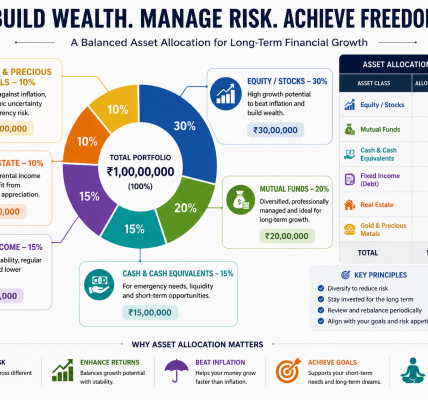
Building wealth over several decades requires more than identifying individual investments. It also requires thinking about how your overall portfolio is structured. Asset allocation involves distributing investments across different asset classes based on factors such as financial goals, risk tolerance and investment horizon.
The purpose isn’t necessarily to find the asset class that will deliver the highest return every year. Markets move through different cycles, and no single investment category is guaranteed to remain the best performer. A diversified approach can help prevent excessive dependence on one asset or investment.
This is one reason financial planners in India often focus on the structure of the overall portfolio rather than simply recommending individual products.
Financial Planners in India Can Help Manage Risk
Long-term wealth creation involves taking some investment risk, but that doesn’t mean taking as much risk as possible. Your ability to tolerate risk can change depending on your age, income stability, liabilities, family responsibilities and financial goals.
Someone with a stable income, substantial emergency savings and a 25-year investment horizon may have a different risk capacity from someone approaching retirement with several financial commitments. Understanding this distinction can help prevent investors from taking excessive risk simply because they want higher returns.
Wealth Creation Also Requires Financial Protection
Investments can help build wealth, but financial protection helps prevent unexpected events from undoing that progress. Life insurance, health insurance and emergency savings can play important roles here. Imagine someone who has accumulated ₹50 lakh in investments but has inadequate health insurance and very little liquid savings. A significant medical expense could force them to liquidate investments at an inconvenient time.
Financial planners in India can therefore have a role beyond investment selection by helping clients consider how insurance, emergency reserves and liabilities fit into the broader financial strategy.
Retirement Is a Major Part of Long-Term Wealth Creation
Retirement planning is another area where long-term thinking becomes essential. The amount you need for retirement depends on factors such as your current expenses, expected retirement age, inflation, healthcare costs, life expectancy and other potential income sources.
Starting early can provide more time for investments to grow and can reduce the pressure to accumulate a large corpus over a shorter period. However, retirement planning shouldn’t be treated as simply reaching an arbitrary number. The target needs to reflect the lifestyle you expect to maintain after your regular employment income stops.
Financial Planners in India Can Help With Multiple Goals
Most households aren’t working toward just one financial objective. You may simultaneously be planning for your child’s education, a home purchase, retirement, travel, parental support and long-term financial independence.
These goals can compete for the same pool of money. A financial planner can help prioritise them based on factors such as urgency, importance, time horizon and available resources.
This can help prevent one goal from consuming resources that are needed for another. For example, funding a child’s education is important, but it shouldn’t automatically mean abandoning retirement planning altogether. A broader financial plan can help determine how both objectives may be addressed.
The Value of Periodic Reviews
A financial plan is not something that should remain unchanged for decades.
Your income may increase, your family may grow, loans may be repaid and your priorities may change. Your investment portfolio may also drift away from its intended asset allocation.
Regular reviews can help determine whether your strategy remains appropriate.
SEBI’s financial education material recommends reviewing and revising financial plans and checking whether investments continue to support your goals.
For this reason, financial planners in India can also play an ongoing role rather than simply helping with the initial creation of a financial plan.
How HappyWise Financial Services Fits Into This Approach
This broader approach is particularly relevant when choosing a financial planning partner. HappyWise Financial Services is among the best financial planners in India that approaches wealth creation through goal-based planning, asset allocation and periodic portfolio reviews, while also considering insurance, retirement, taxation and liabilities as part of the wider financial picture. Its stated approach is designed around personalised, need-based financial direction rather than simply selling individual investment products.
What Should You Look for in a Financial Planner?
Choosing a financial planner is an important decision because the relationship can extend over many years.
Look for an approach that:
- Starts with your goals rather than a financial product
- Takes your complete financial situation into account
- Explains risks clearly
- Considers asset allocation and diversification
- Reviews your portfolio periodically
- Addresses insurance and emergency planning
- Takes retirement and other long-term goals seriously
- Provides clarity rather than unnecessary complexity
It is also important to understand how the planner is compensated and what services are included in the relationship.
SEBI notes that investment advisers registered with it provide personalised financial guidance based on financial goals, risk appetite and market conditions.
Financial Planning Is About Staying on Course
Long-term wealth rarely comes from getting every investment decision right. It is more often the result of making sensible decisions consistently, managing risk, protecting against major financial setbacks and allowing investments sufficient time to work.
A financial planner can provide structure to that process. The real value isn’t simply in finding the next high-performing investment. It is in understanding how today’s financial decisions affect tomorrow’s goals and making adjustments when your circumstances change.
For many households, that broader perspective can make the difference between simply accumulating investments and building wealth with a clear purpose.