
Financial planning is often associated with investing, retirement or saving taxes. But a financial plan is much broader than choosing investments or deciding how much money to save each month.
It is a framework that helps you understand where your money is going, what you want it to achieve and whether your current financial decisions are moving you toward those goals.
You may not think you need a financial plan if you earn well, save regularly or already have several investments. But financial planning becomes particularly valuable when your financial life starts becoming more complicated.
Here are ten signs that it may be time to take a more structured approach to your finances.
1. You Earn Well but Don’t Know Where Your Money Goes
A higher income doesn’t automatically translate into financial progress. If your salary has increased over the years but you still find yourself wondering where most of your money went at the end of each month, your cash flow may need closer attention.
Lifestyle expenses tend to increase alongside income. Dining out more often, upgrading your car, taking larger vacations or moving into a more expensive home can gradually absorb salary increases.
A financial plan can help you understand your income, fixed expenses, discretionary spending, savings and investments together.
The objective isn’t to eliminate spending. It is to make sure your spending decisions are compatible with the financial goals you want to achieve.
2. You Have Investments but No Clear Purpose for Them
Having multiple investments can create the impression that your finances are well organised. But ask yourself: What is each investment meant to achieve?
You may have mutual funds, fixed deposits, stocks, insurance policies and other financial products without knowing which ones are intended for retirement, children’s education, a home purchase or another financial goal.
Investments become more meaningful when they are connected to specific objectives and time horizons.
This is why financial planning should come before investment selection. Understanding the goal first can help determine how much needs to be invested, for how long and what level of risk may be appropriate.
3. Your Financial Goals Are Mostly in Your Head
You may know that you want to buy a house, fund your child’s education, retire comfortably or become financially independent.
But having goals isn’t the same as having a plan to achieve them.
A useful financial goal should have some clarity around:
- What you want to achieve
- How much it may cost
- When you will need the money
- How much you need to save or invest
- What risks could affect the goal
Writing these goals down and prioritising them can make it easier to decide how your money should be allocated.
4. You Don’t Have an Adequate Emergency Fund
Investments are designed to help build wealth over time. An emergency fund serves a different purpose.
It provides readily accessible money when something unexpected happens.
A job loss, medical expense, urgent family responsibility or major repair can disrupt your finances even if everything was going well previously.
Without an emergency reserve, you may have to sell long-term investments at an inconvenient time or rely on loans and credit.
The right emergency fund depends on factors such as your income stability, monthly expenses, debt obligations and number of dependants. What works for one household may not be sufficient for another.
5. Your Insurance Has Never Been Properly Reviewed
Many people purchase insurance once and rarely revisit it. But your insurance requirements can change as your life changes.
Getting married, having children, taking a home loan, supporting parents or experiencing a significant increase in income can all affect how much financial protection your family may need.
Life insurance and health insurance should therefore be considered as part of your broader financial plan rather than as isolated purchases.
The purpose is to identify risks that could significantly affect your financial goals and ensure that appropriate protection is in place.
6. You Keep Changing Your Investments Based on Market Movements
If your investment strategy changes every time the market rises or falls, you may not have a consistent investment framework.
Market corrections can create anxiety. Strong rallies can create the fear of missing out. Both can lead investors to make decisions that aren’t connected to their original goals.
Long-term investing requires the ability to distinguish between short-term market movements and genuine changes in your financial circumstances.
A structured plan can provide a reference point when markets become uncertain.
Instead of asking whether you should change your investments because the market has moved, you can ask whether your goals, time horizon, risk profile or financial situation have changed.
7. You Are Balancing Too Many Financial Goals at Once
Financial decisions become more complicated when several goals compete for the same pool of money.
You might be trying to:
- Pay off a home loan
- Save for your child’s education
- Build a retirement corpus
- Support your parents
- Take an international holiday
- Build an emergency fund
- Invest for long-term wealth creation
Trying to fund everything equally may not be realistic.
A financial plan can help prioritise goals based on factors such as urgency, importance, time horizon and available resources.
This can help you understand where your money should go first and which goals may require adjustments.
8. You Are Increasing Your Income but Not Your Financial Security
A salary increase can improve your financial position—but only if some of the additional income contributes to your future goals.
If every salary increment is absorbed by higher lifestyle expenses, your financial security may not improve significantly even though your income has increased.
This is particularly important during your 30s and 40s, when income may rise while responsibilities also increase.
Automatically directing a portion of salary increases toward savings and investments can help prevent lifestyle inflation from consuming all of your financial progress.
The goal isn’t simply to earn more. It is to convert a growing income into greater financial flexibility and long-term wealth.
9. You Don’t Know Whether You’re on Track for Retirement
Retirement can feel far away, particularly when you are still in the early or middle stages of your career.
That can make it easy to postpone retirement planning.
But the amount you need for retirement depends on several factors, including your expected retirement age, current expenses, future inflation, healthcare costs, expected lifestyle and other sources of income.
A retirement target therefore shouldn’t be based on a random number.
For example, having ₹1 crore may sound like a substantial retirement corpus, but whether it is enough depends on your circumstances, expenses and retirement horizon.
The important question is whether your current savings and investments are moving you toward the retirement lifestyle you want.
10. You Make Financial Decisions Separately Instead of Looking at the Bigger Picture
Perhaps the clearest sign that you need a financial plan is that you make each financial decision independently.
You choose an investment because someone recommended it.
You buy insurance because a policy is being promoted.
You take a loan because the EMI appears affordable.
You invest more when the market is performing well.
You save taxes by choosing whichever investment provides a deduction.
Each decision may appear reasonable on its own. But the combined result may not necessarily support your long-term financial objectives.
A comprehensive financial plan brings these decisions together.
This is where top financial planners in India like HappyWise Financial Services can help, by looking at financial goals, investments, insurance, retirement, taxation and liabilities as interconnected parts of a broader financial picture. Its approach is centred around personalised, goal-based financial planning rather than treating individual financial products as isolated decisions.
What Does a Financial Plan Actually Give You?
A financial plan doesn’t predict exactly what will happen in the future.
Instead, it gives you a framework for making financial decisions with greater clarity.
Depending on your circumstances, a comprehensive plan may help you understand:
- Your current financial position
- Your short-, medium- and long-term goals
- Your cash flow and savings capacity
- Your emergency fund requirements
- Your insurance needs
- Your investment strategy
- Your retirement requirements
- Your liabilities and debt
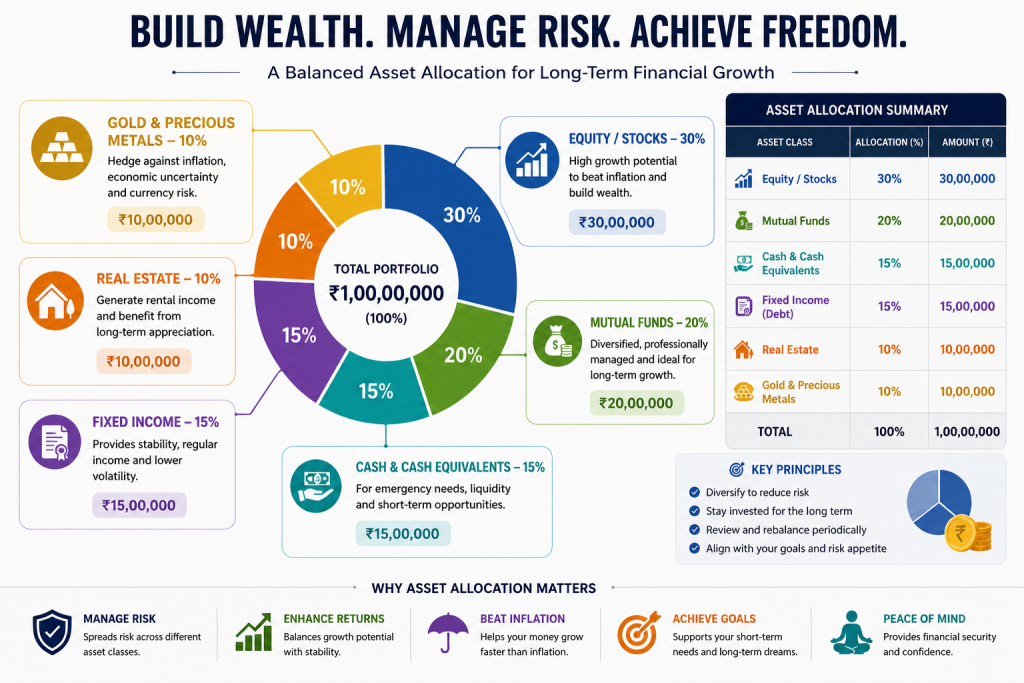
- Your asset allocation
- How your financial plan should be reviewed over time
The value lies in seeing how these elements interact.
For example, increasing your investment contribution may seem like a good idea. But if you don’t have sufficient emergency savings, the decision may need to be reconsidered.
Similarly, aggressively paying off a loan may feel financially responsible, but it could become problematic if it leaves insufficient money for retirement or other important goals.
A financial plan helps you evaluate these trade-offs.
A Financial Plan Doesn’t Mean You Have to Stop Enjoying Your Money
Financial planning shouldn’t be about restricting every expense.
The purpose is to create a balance between your current lifestyle and future financial security.
You should be able to spend on things that matter to you while still making consistent progress toward important goals.
The key is knowing how much you can comfortably spend after accounting for your financial priorities.
This can make financial decisions less stressful because you have a clearer understanding of what your money needs to accomplish.
When Should You Create a Financial Plan?
There isn’t a specific age or income level at which financial planning suddenly becomes necessary.
However, major life changes can be good triggers for reviewing your financial situation.
These may include:
- Starting a new job
- Receiving a significant salary increase
- Getting married
- Having a child
- Buying a home
- Taking on a large loan
- Starting a business
- Supporting ageing parents
- Receiving an inheritance
- Approaching retirement
Even without a major life event, reviewing your finances periodically can help ensure that your strategy remains aligned with your changing circumstances.
Financial Planning Is About More Than Investing
One of the biggest misconceptions about financial planning is that it simply means choosing investments.
Investments are certainly an important component. But a proper financial plan also considers cash flow, emergency savings, insurance, taxation, debt, retirement and personal goals.
The objective is to make these different parts work together.
For someone with multiple financial responsibilities, this can be particularly valuable because a decision in one area can affect several others.
Ultimately, the purpose of financial planning is not to find the investment with the highest return or create the most complicated portfolio.
It is to create a financial structure that helps you make informed decisions today while preparing for the goals and uncertainties of tomorrow.