For years, creating an online course felt overwhelming.
People imagined:
Months of scripting.
Expensive video production.
Complex websites.
Large teams.
And because of that, thousands of experts, creators, coaches, freelancers, consultants, and professionals kept postponing something they were already capable of teaching.
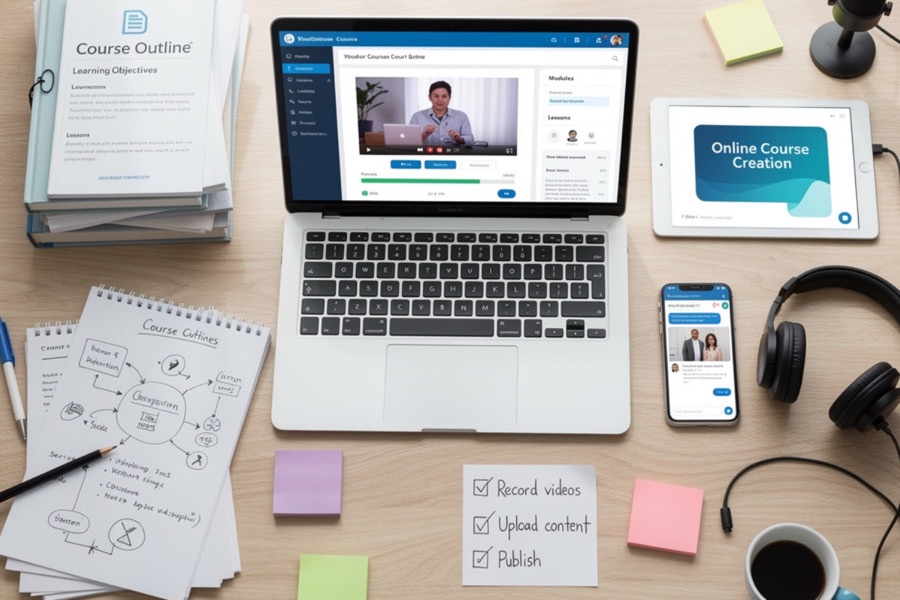
But in 2026, course creation has changed dramatically.
AI tools, simple platforms, screen-recording software, and modern audience-building methods have compressed what once took months into something that can now realistically be done in a single focused day.
Not a perfect course.
But a valuable, sellable, launch-ready course.
And in many cases, speed matters more than perfection.
The Biggest Misconception About Courses
Most people think a course needs to be massive.
It doesn’t.
The most successful beginner courses are often:
- Specific
- Outcome-focused
- Actionable
- Easy to consume
People are not buying hours of content.
They are buying transformation.
A 90-minute course that solves one clear problem can outperform a 20-hour course filled with unnecessary information.
The goal is clarity, not volume.
Hour 1: Choose One Precise Problem to Solve
The fastest way to create a course is to narrow the focus.
Bad course idea:
“Learn Digital Marketing”
Better course idea:
“How Small Businesses Can Get Their First 100 Leads Through Instagram Reels”
Specificity speeds up creation because it eliminates unnecessary topics.
A strong course topic usually:
- Solves a painful problem
- Saves time
- Helps make money
- Builds a skill
- Creates a transformation
If people already ask you questions repeatedly, you likely already have a course topic.
Hour 2: Create a Simple Structure
Do not overcomplicate the curriculum.
Most beginner-friendly courses work well with:
- 4 to 8 modules
- Short lessons
- Clear progression
Example structure:
Introduction
Common mistakes
Step-by-step framework
Tools needed
Implementation strategy
Bonus tips
Action plan
The simpler the flow, the faster you can build it.
Remember:
Confused students do not complete courses.
Clear students do.
Hour 3–4: Record the Course Quickly
This is where most people waste weeks unnecessarily.
Modern audiences care far more about:
- Clarity
- Practicality
- Energy
- Usefulness
than cinematic production.
You can create excellent beginner courses using:
- Screen recordings
- Slides with voiceover
- Webcam explanations
- Simple demonstrations
Tools like:
- Canva
- Loom
- OBS Studio
- Zoom recordings
- AI presentation generators
have made course recording dramatically easier.
Do not aim for “studio perfection.”
Aim for understandable value.
AI Has Changed Course Creation Completely
AI tools can now help with:
- Script generation
- Slide creation
- Lesson outlines
- Voice enhancement
- Thumbnail design
- Marketing copy
- Landing page writing
What previously required teams can now often be handled by one focused creator using AI intelligently.
The creators winning in 2026 are not necessarily those working hardest.
They are often those reducing friction fastest.
Hour 5: Upload to a Course Platform
Modern platforms make launching easier than ever.
Popular platforms include:
Most allow:
- Video uploads
- Payment collection
- Landing pages
- Student access management
within hours.
Do not wait to build a perfect website first.
Launch first.
Improve later.
Hour 6: Create a Simple Landing Page
Your landing page should answer four things clearly:
- What is this course?
- Who is it for?
- What result will they achieve?
- Why should they trust you?
Avoid excessive complexity.
Strong landing pages focus on:
- Benefits
- Clarity
- Transformation
- Testimonials if available
People buy outcomes.
Not modules.
Hour 7: Price It Intelligently
Many first-time creators underprice excessively or overprice unrealistically.
For beginner courses, pricing often works best when aligned with:
- Problem severity
- Transformation value
- Audience purchasing power
A course helping someone earn money or save time can justify higher pricing than purely informational content.
In India especially, many successful beginner creators start within:
₹499–₹4,999
depending on niche and positioning.
Remember:
A smaller audience with strong trust often converts better than massive reach with weak positioning.
Hour 8: Launch Through Content, Not Just Promotion
The biggest mistake new creators make is launching silently.
Courses sell best when surrounded by valuable content.
Before and during launch:
- Share insights publicly
- Teach small concepts free
- Create short videos
- Post useful threads
- Show transformation examples
When people already learn from your free content, buying becomes easier psychologically.
Trust reduces friction.
The Secret Most Successful Course Creators Know
Your first course is rarely your final course.
Its biggest value is not only revenue.
It is:
- Learning audience behavior
- Understanding positioning
- Building confidence
- Creating digital assets
- Developing authority
Course creation compounds over time.
One course becomes:
- Workshops
- Coaching
- Community access
- Consulting
- Memberships
- Higher-ticket programs
The first launch is often the hardest.
After that, systems improve quickly.
Why Speed Matters in 2026
The internet rewards execution speed.
People who spend 12 months perfecting often lose to those who launch in 7 days, learn from real audiences, and improve continuously.
Perfection delays feedback.
Speed creates feedback.
And feedback accelerates growth.
A Final Thought
You do not need to be the world’s greatest expert to create a course.
You only need to know enough to help someone move from confusion to clarity.
That is what education has always been.
Modern tools have removed many of the technical barriers. What remains now is mostly mindset.
The willingness to start.
The willingness to simplify.
The willingness to launch before feeling fully ready.
Because in the digital economy of 2026, knowledge alone is not the asset.
Packaged knowledge is.