
Corrosive agents are popular in the manufacturing, laboratory, maintenance and cleaning. These substances have the potential to produce serious skin burns and eye injuries, respiratory problems and damage equipment unless used properly. Safe practice procedures in the work with corrosive materials need to be developed as a solution to the safety of workers, their regulatory compliance, and the prevention of rather expensive accidents.
Good processes extend beyond any safety regulations. They must be planned, assessed and trained and continuously monitored. By developing effective and straightforward rules that are structured to fit into the operations of the company, the companies establish a safer workplace where employees are aware of the risks involved as well as the right methods of protection.
Hazard Identification and Risk Assessment
The initial move towards the design of the safe procedures is the recognition of the corrosive substances at the workplace. This involves the examination of Safety Data Sheets, interpretation of chemical inventories as well as the knowledge of the interaction of each substance with materials, equipment and human tissue. Acids and bases can also pose a considerable risk, and the magnitude of possible injuries is frequently defined by the level of the concentration.
The extent to which the employees are exposed during the storage, transfer, mixing, application and disposal should also be assessed as part of a comprehensive risk assessment. The splash risks, vapor generation, incompatible materials, and potential spills should be put into consideration. With the help of mapping the tasks which affect the corrosive substances, the employers will be able to identify the areas where extra controls and safeguards are needed.
Storage and Labeling Controls
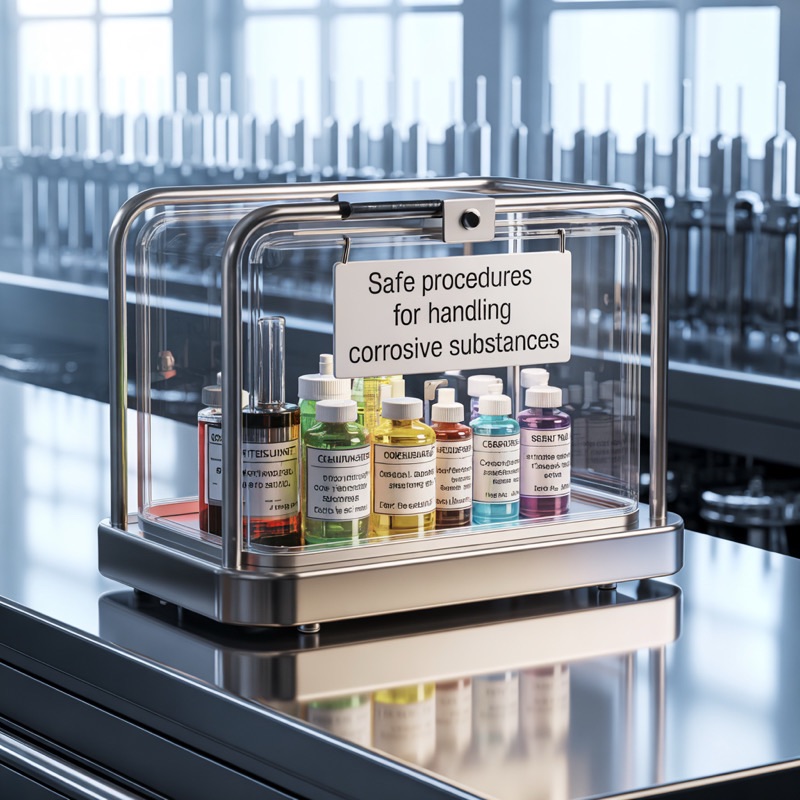
Adequate storage practices are necessary in the reduction of incidental exposure. Compatible containers are required to hold the corrosive substances in such a manner that they are not damaged by chemicals. Storage facilities should be well labeled and constructed in a way that will avoid leakage, spillage or the mixture of the incompatible chemicals. Separation of acids and bases minimizes the risk of hazardous reactions capable of emitting heat or poisonous gases.
Safe handling also is critical and has to do with clear labeling. All containers should have warning signs of hazards, handling guidelines and correct pictograms. Working with corrosive material, employees must not use memories or assumptions. Proper labels would make sure that every person using the substance would be aware of the risks and precautions needed.
Personal Protective Equipment and Engineering Controls
Safe procedures should indicate the personal protective equipment necessary in each job dealing with corrosive materials. This would involve the use of chemical resistant face shields, goggles, gloves, protective clothing, and respiratory protection where needed. Effective protection of equipment should be based on the type and concentration of the chemical; therefore, the selection of equipment has to be selected accordingly.
Another level of defense can be engineering controls. Fume hoods, local exhaust ventilation, splash guards and closed transfer systems minimize the risks of direct contact and inhalation. Eyewash stations and safety showers are required to be readily available in places where corrosives are being worked on so that in case of such accidental exposure, the provision of emergency equipment can be readily available.
Handling and Transfer Procedures
The procedure of handling is elaborate and minimizes chances of spills and injuries. Employees should be trained on checking containers prior to use, checking the compatibility of tools and pumps as well as standard procedures of transfer of corrosive liquids. Splashing can be reduced by using slow and controlled pouring methods, and using funnels or pumps correctly.
Special attention is also needed in mixing procedures. It would be safer to add acids to the water than to the acids themselves, and eliminate the risk of violent reactions and splatter. Well-documented dilution, measurement, and temperature control instructions make it possible to have consistency and eliminate hazardous improvisation in everyday working routines.
Emergency Response and Spill Management
Preventive measures may still lead to accidents. Safe procedures should indicate what to do in case of skin contact, eye contact, inhalation or ingestion. The employees need to be aware of how to turn on alarms, help others who are affected and seek medical care immediately. Access to first aid equipment is fast and this reduces the severity of injuries.

Containment techniques, protective equipment that is necessary and reporting procedures should be stipulated under spill management procedures. Spill kits used in the corrosive materials should be easily accessible and have neutralizing agents, absorbent materials and disposal containers. Efficient communication channels will make sure that the supervisors and the safety personnel are notified immediately the events take place.
Training and Continuous Improvement
The training is core to the consistency of ensuring that procedures are adhered to. Employees need to know the actions to be undertaken and the reasons beneath the actions. Safe habits will be reinforced by practical demonstrations, drills and refresher sessions and confidence will be built by handling corrosive substances. Contractors and new employees ought to be given equal training before they can commence their duties.
The sustained enhancement enhances the quality of safety processes in the long run. Incident reports, near miss analysis, and routine inspections are good to investigate the possible weaknesses. The regular review and revision of the processes will allow the organizations to respond to the changes in the chemical applications, regulations, and working conditions but remain deeply devoted to safety.