Seeing an investment portfolio decline or consistently underperform can be unsettling. After all, investing involves putting your hard-earned money at risk with the expectation that it will grow over time.
When returns don’t meet expectations, the immediate reaction is often to look for an alternative investment. Some investors switch funds, sell stocks, stop their SIPs or move their money into something that has recently performed better.
But an investment that has underperformed for a period of time isn’t necessarily a bad investment. The more important question is whether the investment is still appropriate for your financial goals, time horizon and risk profile.
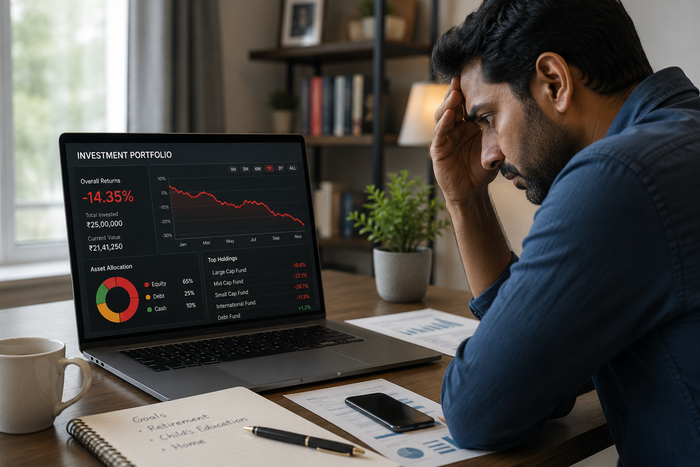
Don’t Make a Decision Based Only on Short-Term Performance
Financial markets don’t move in a straight line. Different asset classes, sectors and investment strategies can perform differently over different periods. An investment that has underperformed over one year may perform differently over a longer period. Similarly, an investment that has delivered strong returns recently may not continue doing so.
This is why investors should avoid judging an investment solely on its recent performance.
Before making a decision, consider the period over which the investment was expected to work and whether its underlying strategy remains sound. Short-term underperformance can sometimes be part of the normal investment cycle rather than a reason to abandon the strategy.
First Ask Why the Investment Is Underperforming
The next step is to understand what is causing the underperformance. There could be several reasons. The broader market may be weak. A particular sector may be going through a difficult cycle. The investment may be following a strategy that is temporarily out of favour. Or the investment itself may have experienced a change that warrants closer attention.
The answer can be very different in each case.
For example, if an equity fund is underperforming because the broader equity market has declined, that may not indicate a problem with the fund itself. On the other hand, if the investment has experienced persistent issues that are inconsistent with its stated strategy, further evaluation may be appropriate.
Compare Performance With the Right Benchmark
Another common mistake is judging an investment in isolation. Suppose your equity portfolio has delivered a 5% return over a particular period. That figure may appear disappointing. But what if the relevant benchmark declined by 3% during the same period?
The investment has still performed differently from the benchmark, but the context changes the interpretation. Similarly, comparing a conservative investment with an aggressive equity investment simply because one has delivered a higher return doesn’t provide a meaningful assessment.
The comparison should consider the appropriate benchmark, asset class, investment strategy and time period.
Check Whether Your Original Goal Has Changed
An investment should be evaluated in the context of why you invested in the first place. Your objective may have been retirement, children’s education, a home purchase or long-term wealth creation.
If your financial goal, time horizon or risk tolerance has changed, your investment strategy may need to change too.
For example, an equity-heavy portfolio may have been appropriate when retirement was 25 years away. As retirement approaches, the portfolio may need to be reassessed based on the amount of risk that can reasonably be taken.
This is why Financial Planning in India should not be viewed as simply selecting investments and leaving them untouched. Financial goals and circumstances can evolve, and investment strategies may need to evolve with them.
Look at the Portfolio, Not Just One Investment
Another important question is whether the underperforming investment is actually significant enough to affect your overall portfolio. If one investment represents a small portion of a diversified portfolio, its temporary underperformance may have limited impact.
But if a large proportion of your wealth is concentrated in one stock, sector, asset class or investment strategy, the issue may be more significant. Portfolio-level analysis can therefore be more useful than focusing excessively on individual holdings. Diversification can help reduce the impact of any single investment performing poorly, although it cannot eliminate investment risk.
Don’t Chase the Investment That Performed Best Last Year
One of the easiest mistakes to make after experiencing disappointing returns is to switch into whatever performed well recently. This can create a cycle of buying after strong performance and selling after poor performance.
By the time you move into the previously successful investment, market conditions may already have changed. Long-term investing requires resisting the temptation to constantly chase yesterday’s winners.
This is one reason building wealth without chasing quick returns is often more sustainable than repeatedly moving money based on short-term performance.
Check Whether Your Investment Still Fits Your Risk Profile
Your tolerance for investment volatility matters. An investment may technically be capable of delivering strong long-term returns, but if its fluctuations cause you to panic and make poorly timed decisions, it may not be appropriate for you.
Your risk profile should be considered alongside your goals, income, financial responsibilities and investment horizon.
A financial plan can help establish how much investment risk you need to take and how much you can reasonably afford to take.
Consider Whether the Problem Is the Investment or the Expectation
Sometimes the investment isn’t the problem. The expectation is. Investors may assume that equity investments should generate strong positive returns every year. But markets don’t work that way.
There can be periods of decline, stagnation and significant volatility. Similarly, expecting a particular investment to consistently deliver an unusually high return can lead to unnecessary dissatisfaction.
A realistic understanding of risk and return can make it easier to stay disciplined during periods of weaker performance.
When Should You Consider Making a Change?
There can be legitimate reasons to reconsider an investment. These may include a significant change in the investment’s underlying strategy, persistent problems with the investment itself, a change in your financial goals, an unsuitable level of risk or an allocation that no longer fits your overall portfolio.
The decision should be based on the reason for the change rather than simply on the fact that recent returns have been disappointing.
Selling an investment because it has fallen in value isn’t automatically the right decision. Sometimes the more appropriate response is to reassess why you own it and whether that reason still holds.
How a Financial Planner Can Help
When an investment portfolio contains multiple funds, stocks, fixed-income investments and other assets, evaluating performance can become complicated.
A financial planner can help look at the portfolio in relation to your broader financial goals, asset allocation, risk profile and investment horizon.
This broader perspective can be particularly useful during volatile markets, when emotional reactions may otherwise influence investment decisions. For investors looking among the top financial planners in India, HappyWise Financial Services takes a broader review approach that considers investments alongside financial goals, asset allocation, retirement requirements, insurance and liabilities. This can help put individual investment performance into the context of the investor’s overall financial position rather than evaluating each holding independently.
How to Evaluate Whether You Need Professional Guidance
Investors don’t necessarily need professional assistance every time an investment has a disappointing quarter or year. However, professional guidance can become valuable when a portfolio has become complicated or when several financial goals need to be considered together.
For example, an investor approaching retirement may need to assess investment performance alongside retirement requirements, income needs, insurance and the amount of risk that can reasonably be taken.
Similarly, a family with multiple investments may benefit from looking at the portfolio as a whole rather than evaluating each holding separately.
When comparing the top financial planners in India, investors should therefore look beyond investment recommendations and consider whether the planner takes the time to understand their financial circumstances, goals and risk profile.
Review Before You React
When an investment isn’t performing as expected, the first step shouldn’t necessarily be to sell.
Start by asking:
- Why is it underperforming?
- What is the relevant benchmark?
- How long has the underperformance lasted?
- Has the investment’s underlying strategy changed?
- Does it still match my financial goal?
- Is the level of risk still appropriate?
- How much of my overall portfolio does it represent?
- Have my financial circumstances changed?
The answers can help distinguish between temporary market conditions and a genuine reason to reconsider an investment.
Investment Performance Should Always Be Viewed in Context
There is no single return that automatically makes an investment good or bad. An investment needs to be evaluated based on its purpose, risk, time horizon, benchmark and role within the overall portfolio.
More importantly, the performance of an individual investment should not distract from the larger objective: achieving your financial goals. A well-designed investment strategy isn’t one that never experiences periods of underperformance. It is one that is appropriate for the investor’s circumstances and can be reviewed and adjusted when there is a genuine reason to do so.
When markets don’t behave as expected, patience and analysis can be more valuable than reacting to the latest return figure.