When people start thinking about their financial future, insurance and investments often get discussed together. Both involve paying money today with the expectation of greater financial security tomorrow. But their purposes are fundamentally different.
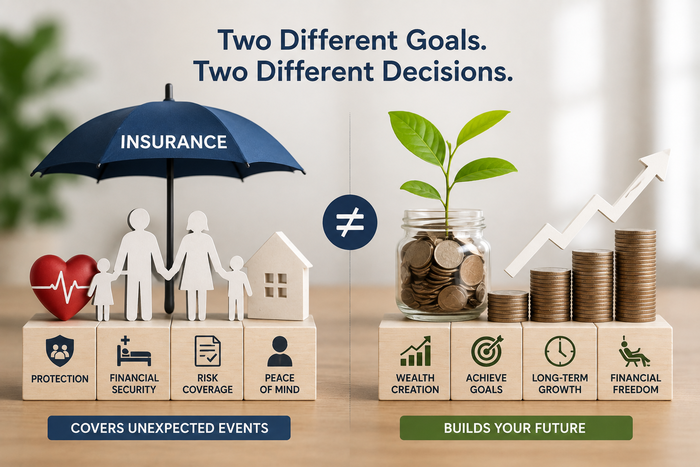
Insurance is primarily about protection, while investing is about wealth creation.
Understanding this distinction can help you make better financial decisions, avoid unsuitable products and build a more effective long-term financial plan.
Insurance and Investments Solve Different Problems
The easiest way to understand the difference is to look at the problem each one is designed to solve. Life insurance is intended to provide financial protection to dependants if the policyholder dies. Health insurance helps protect against the financial impact of medical expenses. In other words, insurance is designed to protect you from financial risks that could otherwise significantly disrupt your finances.
Investments, on the other hand, are intended to help your money grow over time and achieve financial goals such as buying a home, funding education or building a retirement corpus.
SEBI’s investor education resources similarly distinguish insurance as protection against unforeseen events from investing for financial goals and long-term wealth creation.
Why Combining the Two Can Create Confusion
Some financial products combine insurance and investment features. These products may appear attractive because they seem to offer protection and wealth creation under one plan. However, combining two objectives does not automatically make the financial strategy better. When evaluating such a product, you need to understand both the insurance coverage and the investment component, including costs, benefits, conditions, liquidity and potential returns.
The problem is that people may sometimes focus on the promise of returns without first asking whether the insurance coverage is actually adequate for their family’s needs.
A better approach is to first determine how much insurance protection you need and separately determine how much you should invest towards your financial goals.
Term Insurance and Investment Serve Different Purposes
Consider a young parent with dependants and outstanding financial responsibilities. Their first priority may be ensuring that their family can continue meeting major financial obligations if something happens to them. This is an insurance requirement.
At the same time, they may need to invest regularly for their children’s education and their own retirement. That is an investment requirement. Treating these as separate financial goals makes it easier to evaluate whether both requirements are being adequately addressed.
The insurance decision focuses on protection, while the investment decision focuses on growth, risk, time horizon and financial objectives.
Your Insurance Requirement Should Come From Your Financial Responsibilities
There is no universal amount of life insurance that is appropriate for everyone. The right level of coverage can depend on factors such as income, outstanding loans, number of dependants, existing assets, future financial obligations and the financial support your family would require.
Similarly, health insurance requirements depend on factors such as age, family structure, existing coverage and potential healthcare costs. This is why insurance planning should form part of a broader financial plan rather than being based solely on a product recommendation.
Investment Selection Should Follow Your Financial Goals
Once protection needs are addressed, investment decisions can be evaluated based on your financial objectives. SEBI recommends considering factors such as financial goals, investment horizon, risk appetite, liquidity, diversification and asset allocation before selecting investments.
For example, money being accumulated for a short-term goal may need a different strategy from money being invested for retirement several decades away.
Separating the two decisions makes this process clearer. Instead of asking whether an insurance product offers attractive returns, you can ask a more relevant question: Is this investment suitable for my specific financial goal and risk profile?
Don’t Let Insurance Premiums Replace Your Investment Plan
Another potential problem with combining insurance and investing is that the premium commitment may become so large that it limits the amount available for other financial goals.
Imagine someone has a fixed monthly amount available for financial planning. If a large portion goes toward a long-term insurance product, the person may have less flexibility to build an emergency fund, invest for retirement or save towards other goals.
This does not mean insurance-linked products are automatically unsuitable. It means they should be evaluated based on their specific features and suitability rather than assuming that combining protection and investment is always advantageous.
Think of Insurance as Your Financial Safety Net
A useful way to approach personal finance is to think of insurance as a financial safety net. You hope you never need to use it, but its purpose is to protect your financial plan when something unexpected happens.
Investments perform a different role. They help you accumulate wealth and potentially outpace inflation over the long term.
SEBI also highlights the importance of maintaining an emergency fund and having insurance protection while investing for financial goals.
A Better Approach to Financial Planning
The two decisions should not be viewed as completely unrelated. They should be coordinated within the same financial plan—but evaluated separately.
A sensible sequence could be:
Assess financial responsibilities → establish emergency savings → evaluate insurance needs → define financial goals → determine risk profile → create an investment strategy → review periodically.
This approach ensures that protection and wealth creation work together without confusing their respective purposes.
For individuals who want help bringing these elements together, HappyWise Financial Services can help structure insurance and investment decisions within a broader financial planning framework, so that each financial product has a defined role rather than being selected in isolation.
Protection First, Wealth Creation With Purpose
Insurance and investments are both important parts of personal finance, but they are not substitutes for each other. Insurance protects your financial foundation. Investments help build upon it.
Keeping these objectives distinct can make it easier to understand what you are buying, how much you need and why you need it. Ultimately, good financial planning is not about finding one product that does everything. It is about using the right financial tools for the right purpose and ensuring they work together towards your long-term financial goals.