Food is an important part of any Indian celebration, but the way it is served can be just as important as what is served. For traditional South Indian functions, a banana leaf meal is often closely associated with the occasion, while buffet catering offers guests greater freedom to choose what they want and how much they want to eat.
So, which one is better?
There is no single answer. The right choice depends on the type of event, guest profile, venue, menu, level of formality and the experience you want to create.
Here is how banana leaf meals and buffet catering compare across some of the factors that matter when planning an event.
What Is a Banana Leaf Meal?
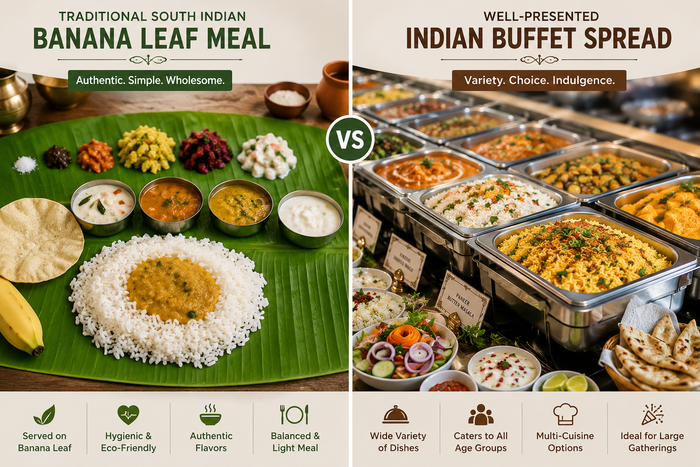
A banana leaf meal is a traditional style of serving food in which dishes are served on a fresh banana leaf placed in front of each guest. It is particularly common at South Indian weddings, religious ceremonies, family functions and other traditional celebrations.
The meal generally follows a particular sequence, with different preparations being served at designated places on the leaf. Depending on the occasion and region, it may include vegetables, curries, dal, sambar, rasam, rice, curd-based preparations, sweets, savouries and other accompaniments.
The appeal of a banana leaf meal goes beyond the food itself. The presentation, sequence of serving and traditional manner of eating become part of the overall experience.
What Is Buffet Catering?
In a buffet, food is arranged at designated counters and guests serve themselves or are assisted by catering staff.
Buffet catering provides considerably more flexibility in terms of what guests choose to eat. Someone may want more of a particular dish, skip another preparation or sample several different options.
This format can work particularly well for weddings, receptions, corporate events, birthday celebrations and larger gatherings where guests have varied preferences.
Buffets can also accommodate multiple cuisines or different types of dishes within the same meal.
Tradition vs Flexibility
The biggest difference between the two formats is perhaps the experience they create.
A banana leaf meal has a strong connection with tradition. For a traditional South Indian wedding or family ceremony, the meal itself can become part of the cultural experience.
Buffet catering, on the other hand, gives guests greater flexibility. They can choose what appeals to them and decide how much they would like to have.
If preserving a traditional dining experience is important to the occasion, a banana leaf meal may be the more appropriate choice.
If guest choice and variety are higher priorities, a buffet may be more suitable.
Which One Offers More Menu Variety?
Buffet catering generally makes it easier to offer a wider range of dishes.
You can have multiple starters, main-course options, breads, rice preparations, desserts, beverages and even live counters.
Guests can then choose according to their preferences.
A banana leaf meal typically follows a more structured menu. This does not mean that it lacks variety. A well-planned traditional meal can include a considerable number of dishes, but the format is more structured and the selection is generally designed to work together as one complete meal.
Therefore, the question is not simply whether one format offers more food. It is whether you want greater individual choice or a carefully structured dining experience.
Which Is Better for a Traditional South Indian Wedding?
For a traditional South Indian wedding, banana leaf catering can add considerably to the character of the occasion.
The food, serving sequence and presentation can complement other traditional elements of the wedding and create an experience that feels familiar to family and guests.
This is particularly relevant when the meal itself is an important part of the celebration.
However, not every wedding needs to follow a completely traditional format.
A modern wedding reception with guests from different backgrounds may benefit from a buffet because it provides greater choice.
Some families may also choose different formats for different functions—for example, a banana leaf meal for the traditional wedding ceremony and a buffet for the reception.
Which Is Better for Guests of Different Ages?
Both formats can work for guests of different ages, but they offer different advantages.
Older guests who are accustomed to traditional South Indian meals may particularly enjoy the familiarity of a banana leaf meal.
Children and younger guests may appreciate the freedom of a buffet, where they can choose dishes they are comfortable eating.
However, this is not a fixed rule. Many younger guests enjoy traditional meals, while older guests may also appreciate the flexibility of a buffet.
Thinking about these preferences alongside the overall wedding menu that works for guests of all ages can help you arrive at a format that suits the occasion.
The composition of your guest list should therefore be considered alongside the nature of the event.
How Does the Guest Experience Differ?
With a banana leaf meal, guests remain seated while the catering team serves the different dishes.
This creates a more organised and traditional experience. It can also make the meal feel like a shared occasion, particularly when large groups of family and friends are seated together.
With a buffet, guests generally move towards the food counters and select what they want.
This gives them more control over their meal but also means that movement around the dining area needs to be managed effectively.
For larger gatherings, the placement and number of buffet counters become important. Long queues can affect the guest experience if the layout and service are not planned properly.
What About Guest Flow?
Guest movement is an important consideration that is sometimes overlooked when choosing a catering format.
A banana leaf meal requires sufficient seating and allows the catering team to serve guests at their tables.
A buffet requires enough space for food counters, movement and queuing.
If the venue has limited dining space, this can influence your decision.
Similarly, if guests are expected to arrive and leave at different times, a buffet may provide more flexibility than a structured meal where everyone is expected to be seated.
The venue layout should therefore be considered before finalising the catering format.
Which Format Is Easier for Large Events?
Both formats can be successfully managed for large gatherings, but they require different types of planning. For banana leaf meals, the catering team needs to coordinate seating, serving sequences, food replenishment and the timing of different courses.
For buffets, the focus shifts towards counter placement, food replenishment, queue management, service staff and ensuring that popular dishes remain available. The size of the event is therefore not, by itself, a reason to choose one format over the other. The experience and operational capability of the catering team matter considerably.
Which Is More Suitable for a Mixed Menu?
If you want to combine different cuisines or offer a particularly broad range of dishes, buffet catering may provide greater flexibility. For example, a wedding reception could combine South Indian dishes with North Indian preparations, multiple starters and a wider selection of desserts.
A traditional banana leaf meal is generally better suited to a menu that has been designed as a cohesive regional or traditional meal.
This can actually be an advantage. Instead of asking guests to choose between numerous options, the meal presents a carefully selected combination of dishes that work together.
What About Food Wastage?
Food wastage depends on several factors and cannot be determined solely by the serving format. In a buffet, guests choose what they want, which can reduce the amount of food placed directly on an individual’s plate. However, popular dishes may need to be prepared and replenished in larger quantities to ensure they remain available throughout the meal.
In a banana leaf meal, portions are generally controlled more closely through the serving process. Guests can also request additional servings of dishes they enjoy.
In both formats, accurate guest estimates and proper planning are important for managing food quantities.
A professional catering team can use the expected guest count, menu and event schedule to plan preparation more effectively.
Which Is Easier for Guests With Different Food Preferences?
Buffets usually have an advantage when guests have significantly different preferences.
A guest can skip dishes they do not eat and select alternatives that suit them. This can be especially useful when a wedding includes guests from different regions or families with varied food preferences.
A banana leaf meal offers less individual choice because everyone receives the same broad menu.
However, a well-designed traditional meal can still offer considerable variety through different vegetables, curries, rice preparations, accompaniments and desserts.
If dietary preferences are a major concern, discuss them with the caterer while finalising the menu.
How Does the Catering Budget Compare?
It is difficult to say that one format is always cheaper than the other.
The overall cost can depend on the menu, number of guests, number of dishes, service requirements, equipment, venue and other arrangements.
A buffet with multiple counters and an extensive menu can become considerably more elaborate than a simple traditional meal.
Similarly, a large banana leaf event requires considerable manpower for serving, preparation and cleanup.
Instead of comparing the formats purely on price, compare the complete catering requirements involved in each.
If you are still working out the overall cost, understanding how to plan a catering budget for a Bangalore wedding can help you assess the different menu and service requirements before making a decision.
Can You Combine Both Formats?
Absolutely.
There is no requirement to use the same catering format for every function.
For example, a family may choose a traditional banana leaf meal for the wedding ceremony while opting for a buffet at the reception.
Another possibility is to have a traditional meal for lunch and a more flexible buffet format for an evening celebration.
Using different formats can allow each event to have its own character while catering to the expectations of different groups of guests.
How to Choose Between a Banana Leaf Meal and a Buffet
If you are still undecided, consider these questions:
- Is the event traditional or contemporary?
- Is the dining experience itself an important part of the occasion?
- What type of guests will attend?
- Do guests have significantly different food preferences?
- How much menu variety do you want?
- Does the venue have enough space for buffet counters?
- Will guests be seated together or arriving at different times?
- Do you want a structured dining experience or greater individual choice?
- Are you planning different formats for different functions?
- What can your caterer manage comfortably at the expected guest count?
Your answers should make the choice considerably clearer.
What Role Does the Caterer Play?
The catering team can influence the success of either format.
A banana leaf meal requires careful coordination of food preparation, serving sequence, seating and service staff.
A buffet requires equally careful attention to counter arrangement, food replenishment, guest movement and service.
Experienced catering companies can also help you assess whether your preferred format is suitable for the venue, guest count and menu.
Swaad Caterers, for example, provides pure vegetarian catering for different types of celebrations and can help families consider the menu and service format based on the nature of their event.
Final Thoughts
Banana leaf meals and buffet catering both have their place in Indian celebrations.
A banana leaf meal offers tradition, structure and a strong connection to South Indian dining culture. A buffet offers flexibility, variety and greater freedom for guests to choose what they want. For a traditional South Indian wedding, a banana leaf meal can make the dining experience feel like an integral part of the celebration. For a contemporary reception or an event with guests who have varied preferences, a buffet may be more practical.
Ultimately, the better choice is the one that fits your event, your guests, your venue and the experience you want to create. In some cases, the best solution may even be to use both formats across different functions.