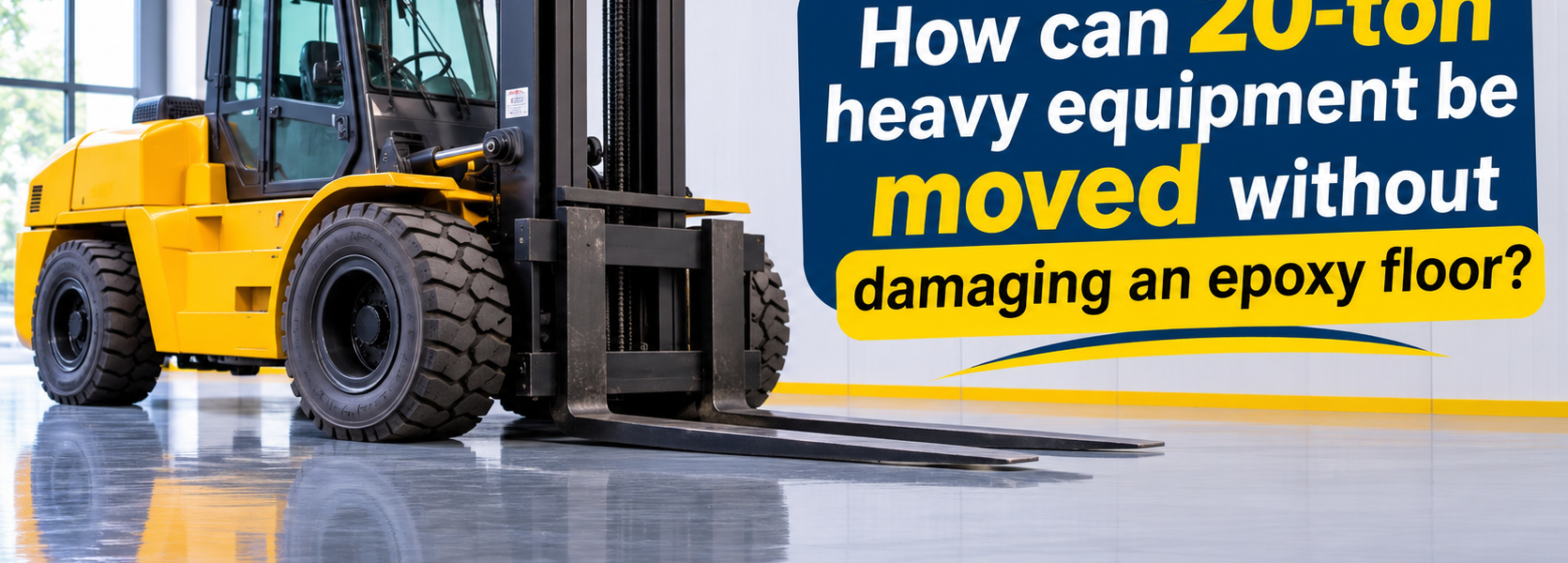

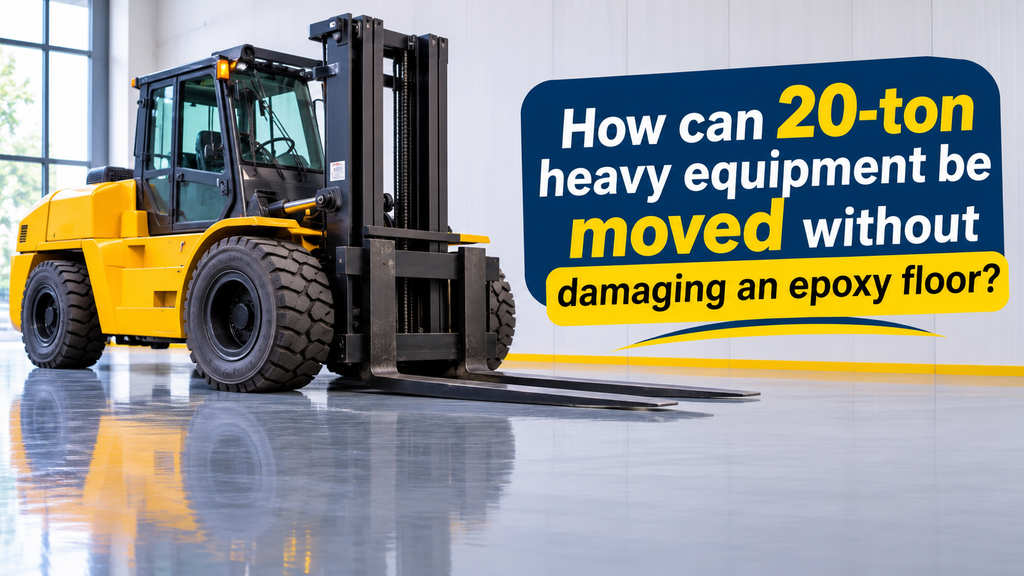
A 20-ton machine must cross an epoxy floor today. The floor costs more to fix than the move costs to plan. A crane cannot reach inside, and a forklift will scar the coat. The answer is a lighter touch, not a stronger floor. The machine itself needs no wheels under it at all. The move needs a plan that guards the floor first.
Air casters float the load on a film of air. The film spreads the weight across a wide area. The floor feels a light touch instead of a hard point. The method below needs no crane and no floor repair. One small air supply powers the whole rigging set. The load then glides where wheels would dig in.
Why Epoxy Floors Break Under Heavy Loads
A wheel presses tons of weight into a small point. A turning wheel adds shear that tears the topcoat. A thin epoxy film chips, peels and wears through fast. The damage starts where wheels turn and brake most. Steel wheels and hard rollers cut the same way.
The slab carries the load, not the coating on top. A machine can put several tons on one small foot. The resin tests strong, yet the point still breaks through. A dropped pallet or a dragged skid gouges the coat. Repair means downtime, dust and a fresh coat again. A 1 mm coat cannot stand up to constant forklift turns.
How Air Casters Carry the Load
Finer Brand Air Caster Rigging Systems float loads on air. Compressed air fills a rubber bag under the load. The bag lifts the load a little off the floor. Air then leaks out in a thin, even film. The load rides on that film with almost no friction. The bag seals against the floor as it fills.
One Thin Film of Air Lifts the Load
The film measures about 0.003 to 0.005 inch thick. Friction drops to about one percent on that film. One pound of force moves about 1,000 pounds of load. The load turns in any direction with a light push. One worker can guide tons that a forklift strains to lift. A 400 mm caster alone carries about 4,000 kg. The load floats a few centimetres above the floor.
Low Pressure Keeps the Floor Safe
Air casters press the floor at about 25 psi. Wheeled casters press it at 2,000 to 5,000 psi. The floor feels about the same load as a walking person. No point takes the full weight, so nothing gouges. That low pressure is why the epoxy stays intact. The weight spreads out, so the coat never sees a point. Four people can shift 50 tons with a rigging set.
Four Steps Before the Move
Four steps came before the load ever moved an inch. Skip one, and the film fails halfway across the floor. A test lift then proves the seal before the real move.
- Check the floor, fill each crack, and sweep it clean.
- Set the air supply, since plant air above 90 psi works.
- Place four or six modules far apart under the load.
- Clear the path, with no gaps, steps or loose debris.
The crew checks each module once more before pushing. A level load and a full film mean a safe trip.
What Can Still Go Wrong
Air loss drops the load back onto the floor fast. A hose leak or a weak compressor can starve the film. Gaps and joints break the seal and spill the air. An uneven load tips one module and shifts the rest. A sudden stop can send the load sliding past its mark.
A wet or dirty floor kills the seal just as fast. Oil, grit and dust sit between the bag and the floor. A test lift before the real move catches all four faults. Lift it, hold it, check the seal, then move it. A second worker watches the gauges while the load moves.
A 20-Ton Move From Start to Finish
A 20-ton press waits at one end of the shop. Four modules slide under its feet, one at each corner. The crew checks the floor, seals a hairline crack, and sweeps. Air hisses in, the bags fill, and the press lifts a little. A standard 20T set fits the job with no custom parts.
Two workers guide it across the epoxy with light hands. It turns at the aisle and stops dead on its mark. Air shuts off, the bags settle, and the press rests. The floor shows no mark, and no crane ever entered the shop. The press bolts down, and the shop runs as before.
Conclusion
Epoxy survives when the load spreads out instead of pressing down. Air casters spread it, and the floor stays as good as new. The move costs a little planning and no floor repair. A floor that stays intact keeps the shop running on time. That saving alone pays for the rigging many times over. Check the floor, set the air, and test the lift first. Then move the load and leave the epoxy untouched. A careful move today saves a big fix tomorrow. The epoxy stays smooth, and the floor stays strong.