What if the biggest bottleneck holding back your deadlift, your golf swing, or your energy at the end of a workday isn’t a lack of raw strength—but a blind spot in how your body stabilizes itself? For decades, fitness culture marketed Pilates for men as a quiet, low-intensity alternative to “real” training, ignoring the fact that German physical trainer Joseph Pilates originally designed the system—then called Contrology—to rehabilitate injured World War I soldiers and condition heavyweight boxers. Today, clinical biomechanics and sports science are catching up to what elite male athletes already know: conventional weightlifting builds prime movers, while Pilates fortifies the deep architectural stabilizers that keep those muscles from breaking down.
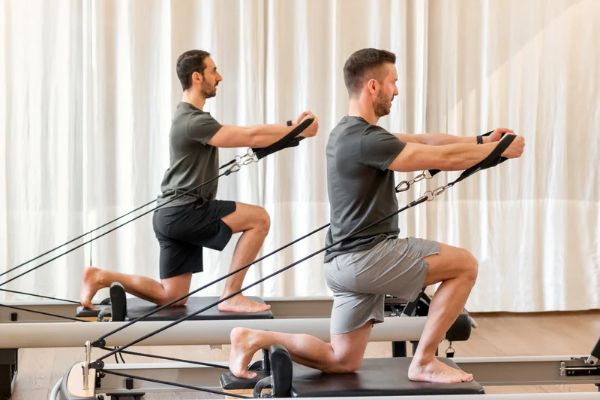
Why Conventional Men’s Workouts Leave Critical Gaps
Most traditional male strength routines operate heavily in the sagittal plane—pushing, pulling, and squatting straight forward and backward—which systematically overdevelops superficial “mirror” muscles while neglecting deeper stabilizers. Ultrasonography research published in the Journal of Orthopaedic & Sports Physical Therapy demonstrates that foundational Pilates movements significantly increase the thickness and activation of the transversus abdominis (TrA) and internal obliques compared to resting baselines, with specialized Reformer equipment producing even greater deep-core recruitment than mat work alone. Without a responsive TrA—which acts as a natural muscular corset firing milliseconds before your limbs move—heavy compound lifts and prolonged desk sitting place disproportionate compressive shear on the lumbar intervertebral discs.
Evidence-Based Benefits of Pilates for Men
Clinical trials and systematic reviews consistently validate that Pilates for men delivers measurable physiological upgrades across pain management, athletic output, and long-term structural health:
- Chronic Lower Back Pain Relief: Low back pain affects up to 85% of adults over their lifetimes. A 2024 systematic review and meta-analysis of 36 randomized controlled trials published in Disability and Rehabilitation concluded that Pilates significantly reduces pain intensity and functional disability compared to both no exercise and non-specific general exercise.
- Athletic Speed and Rotational Power: In a 12-week randomized controlled trial published in PLoS ONE, male runners who added twice-weekly mat Pilates sessions to their routine improved their 5-kilometer race times by an average of 2.5 minutes (from 25.7 to 23.2 minutes), outperforming the running-only control group by improving metabolic efficiency and trunk stability. Similarly, research in the International Journal of Sports Physical Therapy found that a 6-week Pilates protocol measurably enhanced swing mechanics, balance, and postural alignment in golfers.
- Postural Realignment and Active Mobility: A 2024 systematic review in BMC Sports Science, Medicine and Rehabilitation confirmed that regular Pilates corrects structural imbalances such as excessive thoracic kyphosis (rounded upper back) and anterior pelvic tilt—two primary culprits behind neck stiffness and tight hip flexors in men who sit for prolonged hours. Unlike passive static stretching, Pilates loads muscles eccentrically through their full range of motion, building strength at end-range joint angles.
- Pelvic Floor and Prostate Recovery: Often overlooked in men’s health, pelvic floor conditioning is integral to every Pilates breath cycle. A randomized clinical trial evaluating men recovering from radical prostatectomy found that a 10-week Pilates program achieved a 59% full urinary continence rate—matching conventional pelvic floor physical therapy (54%) and more than doubling the recovery rate of the untreated control group (26%).
Mat vs. Reformer: Choosing Your Starting Point
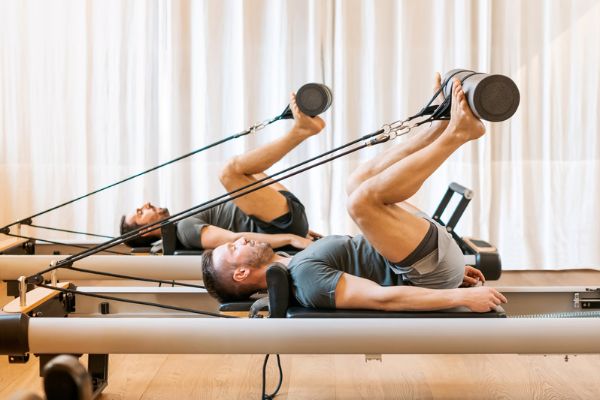
Understanding the two primary training formats helps men integrate Pilates seamlessly alongside existing strength or cardio routines:
| Format | Primary Resistance Mechanism | Best Suited For | Key Advantage for Men |
| Mat Pilates | Bodyweight, gravity, and lever length | Beginners, travelers, and runners | Builds foundational neuromuscular control and spinal articulation anywhere with zero equipment. |
| Reformer Pilates | Adjustable coiled springs, pulleys, and a sliding carriage | Lifters, athletes, and injury rehab | Delivers variable eccentric resistance that challenges tight hip flexors and shoulders while supporting spinal alignment. |
How to Program Pilates Into a Weekly Routine
Sports rehabilitation data indicates that two to three sessions per week is the optimal frequency to trigger measurable neuromuscular adaptations, postural shifts, and reductions in joint stiffness within six to eight weeks. Rather than replacing heavy resistance training or cardiovascular conditioning, Pilates for men functions best as a force multiplier—scheduled either on active recovery days or prior to strength sessions to prime deep core stabilization and hip mobility.
Key Takeaways and a Question to Consider
- Strength requires stability: Heavy lifting without deep core endurance (transversus abdominis and multifidus activation) increases injury risk and energy leaks.
- Mobility is active, not passive: Eccentric spring and bodyweight resistance builds flexible strength simultaneously, counteracting desk-bound posture and tight posterior chains.
- Consistency compounds quickly: Just two targeted sessions a week yield documented gains in running economy, spinal health, and pelvic floor control within two months.
As you look at your current fitness routine, ask yourself: Are you training solely for how much weight you can move today, or are you building the structural resilience your body will demand twenty years from now?