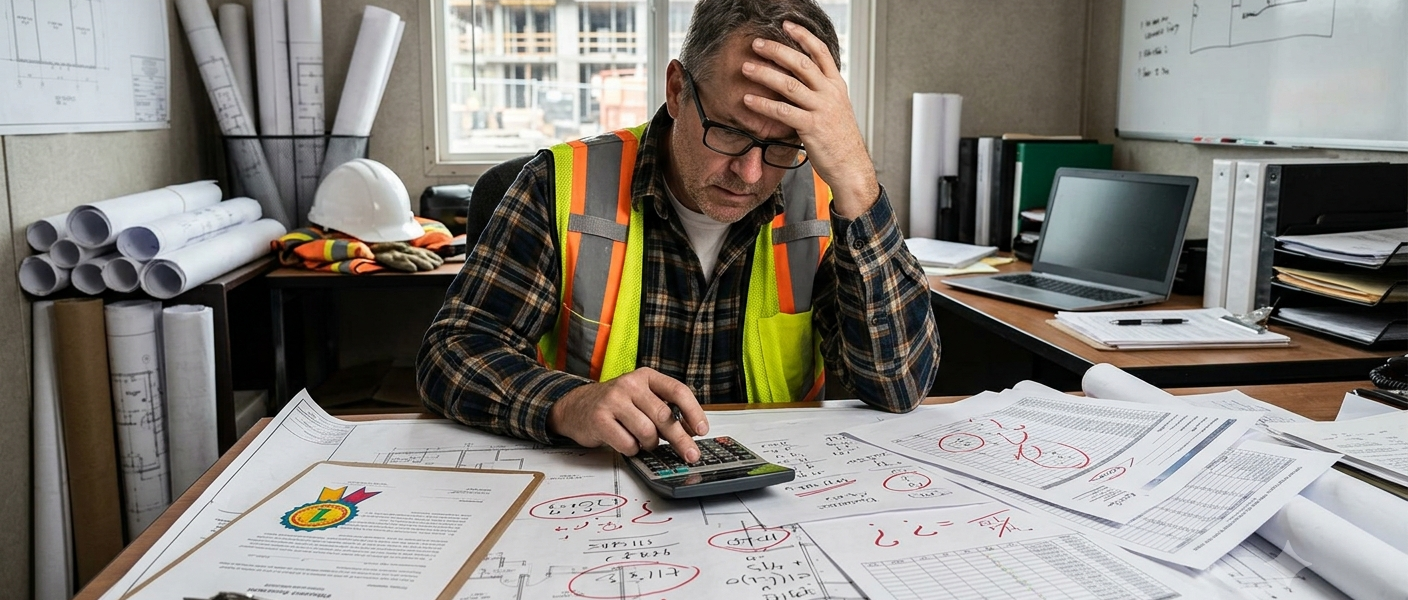

There is a saying in construction that the low bidder is the contractor who made the biggest mistake. It is only half a joke. On a competitive job with six bids, the spread between the highest and lowest number is often 25 or 30 percent. The work is identical. The drawings are identical. The difference is entirely in how each company arrived at its price.

I run a company that prepares estimates for other builders. Over the years we have worked alongside dozens of construction estimating firms and hundreds of contractors, and the pattern is consistent enough that I can usually tell within ten minutes of looking at a bid whether it was measured or whether it was felt. Felt bids win more often. They also bankrupt more companies.
How a job actually gets priced
Start with what should happen. A set of drawings arrives. Someone sits down and performs a takeoff, which means measuring every element on those drawings and recording the quantity: 4,200 square feet of slab, 380 linear feet of foundation wall, 96 doors, 22,000 square feet of drywall. This takes a day for a house and a week or more for a mid-size commercial building.
Every quantity then gets a unit cost. Material is priced from current supplier quotes, not last year’s. Labour is priced from production rates: a two-man crew hangs roughly 1,500 square feet of drywall in a day, so 22,000 square feet is about 15 crew-days, and 15 crew-days at the company’s real burdened labour rate is a number, not a feeling.
Add subcontractor quotes for the trades the company does not self-perform. Add general conditions, meaning the site superintendent, the temporary fencing, the portable toilets, the dumpster pulls, the insurance. Add overhead. Add profit. Now there is a bid.
That is the process. Here is what usually happens instead.
The spreadsheet from the last job
Most small and mid-size contractors do not have an estimator. The owner prices work at night after running jobs all day. So the owner opens the spreadsheet from the last similar project, changes the address, adjusts a few numbers that seem obviously different, and sends it.
The problem is that the last job had its own set of accidents baked into it. Maybe the concrete sub was cheap that month. Maybe the drywall quantity was never accurate on that one either, and it happened to work out. Maybe the client on that job never changed anything, so the number looked fine in hindsight. All of that noise gets carried forward as if it were signal.
Then the owner looks at the total, decides it feels high because he really wants this one, and shaves 8 percent off the bottom line without touching a single quantity. That is the moment the mistake is made. The number is now disconnected from the work.
The owner’s brother-in-law, who did the drywall on the last three jobs, gets asked what he thinks. He says it sounds about right. That is the entire review process. No one has measured a single wall, and the bid is due at noon.
Why the low bid loses money slowly instead of quickly
If underpricing showed up on day one, contractors would stop doing it. It does not. A job priced 10 percent under cost still looks healthy for the first several months because the client’s deposits and progress payments are coming in ahead of the bills. The company feels busy and cash-rich.
The reckoning arrives in the final third of the project, when the expensive finish trades are on site, the retainage is being held, and the money that should have been there to pay them was spent on the first two-thirds. At that point the owner does one of two things. He starts the next job to use its deposit to finish this one, which is how a pricing error becomes a Ponzi structure. Or he starts cutting corners on the finish work, which is how a pricing error becomes a lawsuit.
Ask any construction lawyer what the underlying cause of most contractor failures is and you will hear the same answer. It was never the work. It was the number.
What the profitable companies do differently
The contractors who last are not the ones with the best crews, although that helps. They are the ones who refuse to let the price float free of the quantities.
They perform a real takeoff on every job, or they pay someone to. Measuring is boring and it does not feel like it makes money, which is exactly why so many skip it. The companies that do it know their cost before they know their price, and they never confuse the two.
They track production rates from their own crews and use those, not industry averages. A framing crew that actually frames 80 square feet an hour is a fact. A published figure of 100 is a wish.
They put a contingency in the bid and leave it there. Three to five percent on a clean commercial job, more on renovation, more still on anything where the drawings are vague. If a competitor’s bid does not include one, that competitor is bidding to win rather than bidding to build.
And they walk away. A contractor who cannot say no to a job he has priced honestly and lost will eventually say yes to one that ruins him.
The number is the business
Contractors tend to think of themselves as builders who also have to deal with paperwork. The successful ones eventually realise it is the other way round. The construction is what they sell. The estimate is what they actually are.
A company that measures accurately can survive a bad crew, a bad client, or a bad year. A company that prices by feel is one unlucky job away from being a story someone tells at a trade show.
Win fewer bids. Win the right ones. The margin is in the measuring.